
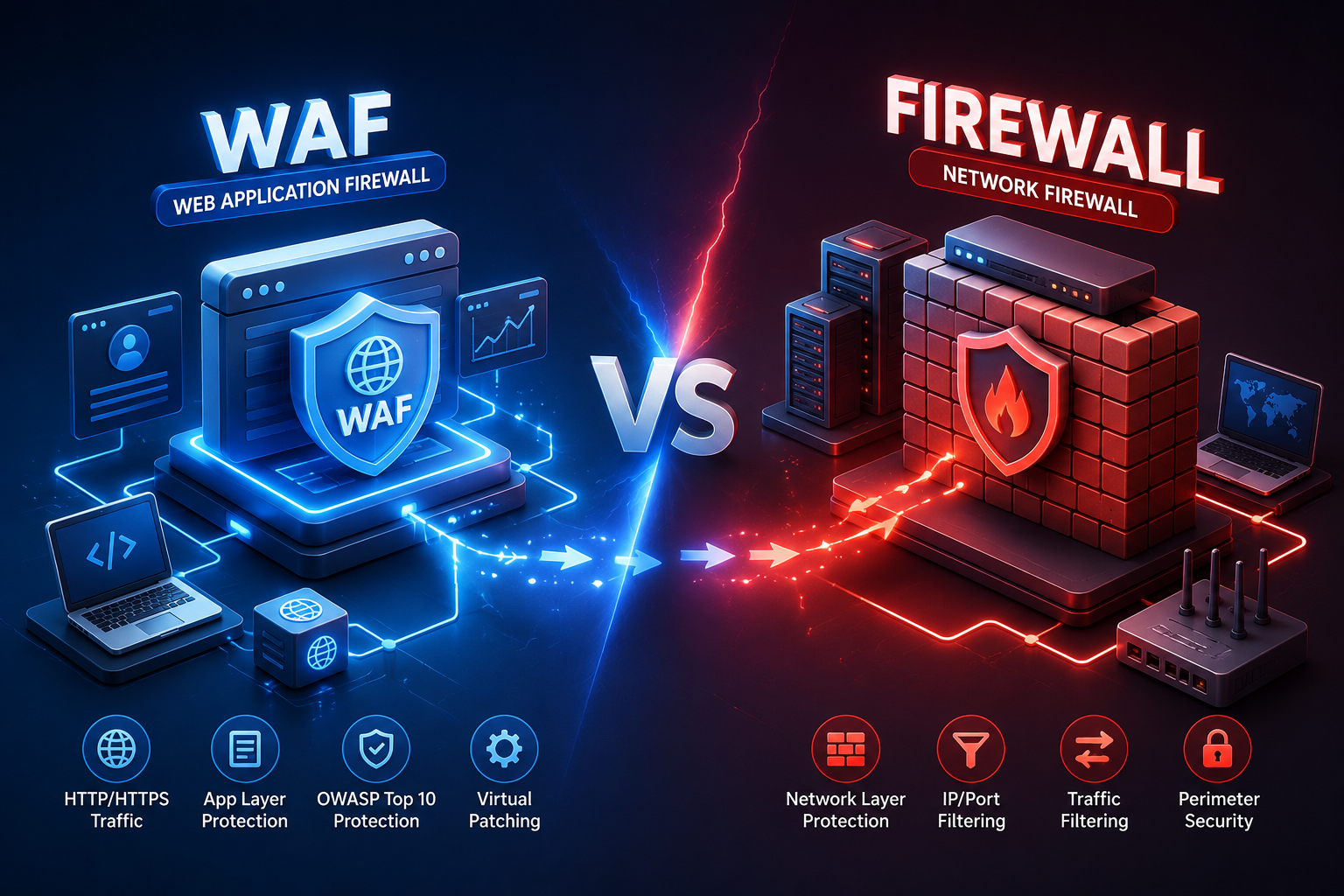
WAF vs firewall is a common comparison for businesses running websites, customer portals, ecommerce platforms, APIs or cloud applications. While both are essential cybersecurity tools, they protect different parts of your IT environment.
The key difference is simple: a firewall protects the wider network, while a web application firewall (WAF) protects web applications. Understanding how each solution works and when to use it can help you build a more effective layered security strategy.
A traditional firewall or next-generation firewall (NGFW) monitors and controls traffic moving in and out of the network, helping protect users, devices, servers and internal systems from unauthorised or malicious activity. A WAF, on the other hand, inspects HTTP and HTTPS requests to websites, web applications and APIs, identifying and blocking attacks that target the application layer.
Rather than choosing one over the other, many organisations benefit from using both. Together, they provide layered protection by securing both the network and the web applications that run on it.
What Is a Firewall and How Does It Work?
A firewall is a security solution that monitors and controls network traffic according to predefined security policies. It determines whether traffic should be allowed, blocked, inspected or restricted before it reaches users or systems.
In a business environment, firewalls typically sit between the internal network and the internet, although they can also protect branch offices, cloud environments, remote workers and internal network segments.
Modern next-generation firewalls go beyond simple traffic filtering. Depending on the deployment, they may include features, such as:
-
Intrusion prevention
-
Application control
-
VPN support
-
Malware protection
-
Web filtering
-
Threat intelligence
-
SSL inspection
-
SD-WAN
-
User-based security policies
Firewalls are commonly used to protect:
-
Office networks
-
Branch locations
-
Servers
-
Users and devices
-
VPN connections
-
Internal systems
-
Cloud and hybrid environments
-
Traffic between trusted and untrusted networks
A firewall works by evaluating every connection against security rules. For example, it can allow approved web traffic, block risky destinations, restrict communication between different network segments or apply security policies to specific users and applications.
Without a firewall, businesses have far less control over what enters, leaves or moves throughout their network.
For Fortinet environments, FortiGate is the primary next-generation firewall platform, providing network protection across on-premises, cloud and hybrid deployments.
What Is a WAF and How Does It Work?
A Web Application Firewall (WAF) is designed specifically to protect web applications and APIs.
Unlike a traditional firewall, a WAF understands the structure and behaviour of web traffic. It inspects HTTP and HTTPS requests before they reach the application, analysing elements, such as:
-
URLs
-
Headers
-
Cookies
-
Form submissions
-
Query strings
-
Login requests
-
API calls
-
Uploaded files
This allows a WAF to identify attacks targeting the application itself rather than the underlying network.
A WAF can help protect against threats, including:
-
SQL injection
-
Cross-site scripting (XSS)
-
Malicious file inclusion
-
Cookie tampering
-
Request forgery
-
Application-layer attacks
-
Suspicious API requests
-
Bad bots
-
Web form abuse
-
Known web application vulnerabilities
When suspicious traffic is detected, the WAF can block, challenge, monitor or log the request before it reaches the application.
Although a WAF cannot fix vulnerable application code, it provides an important security layer that helps reduce the risk of exploitation while developers address underlying issues.
For Fortinet customers, FortiWeb is the dedicated web application firewall and API protection solution, designed to secure websites, web applications and APIs from known and emerging threats.
WAF vs Firewall: Key Differences
The biggest difference between a WAF and a firewall is what they are designed to protect.
A firewall protects the network, while a WAF protects the web application.
Firewalls focus on network traffic, ports, protocols, users, devices and security zones. A WAF focuses on the content and behaviour of web requests sent to websites, APIs and web applications.
For example, a firewall may allow HTTPS traffic because encrypted web traffic is expected. However, an attacker could hide a SQL injection attempt or malicious payload inside that approved HTTPS request. A standard firewall may not recognise the attack because it operates at a different layer.
A WAF is specifically designed to inspect these requests, identify malicious behaviour and stop attacks before they reach the application.
For organisations running public-facing websites or APIs, using both technologies provides stronger protection than relying on either one alone.
|
Area |
Firewall |
WAF |
|
Main role |
Protects networks and traffic |
Protects web applications and APIs |
|
Primary layer |
Network and transport layers (plus application visibility with NGFW) |
Application layer |
|
Traffic focus |
Ports, protocols, IP addresses, users and applications |
HTTP and HTTPS requests |
|
Protects |
Users, devices, servers and networks |
Websites, web applications, login pages and APIs |
|
Common threats |
Unauthorised access, malware and network attacks |
SQL injection, XSS, bad bots and API abuse |
|
Fortinet example |
FortiGate |
FortiWeb |
|
Best suited for |
Network security and perimeter protection |
Web application and API security |
|
Do you need it? |
Almost every business |
Businesses with public-facing web applications |
Do You Need a WAF, a Firewall or Both?
For most businesses, the answer is both.
A firewall and a WAF serve different purposes, so one does not replace the other. A firewall secures the network by controlling traffic between trusted and untrusted environments, while a WAF protects web applications by inspecting the requests sent to them.
This distinction is important because web applications are designed to accept HTTP and HTTPS traffic from users. A firewall may allow this traffic because it complies with network security policies, but attackers can hide malicious requests inside otherwise legitimate web traffic.
For example, a firewall may determine that HTTPS traffic is permitted. A WAF goes a step further by analysing whether that HTTPS request contains a SQL injection attempt, malicious script or other application-layer attack.
A WAF also cannot replace a firewall. While it protects websites, APIs and web applications, it does not provide broader network security functions such as VPN management, network segmentation, SD-WAN, user access control or traffic management.
As a general guide:
-
Use a firewall to protect networks, users, devices and internet access.
-
Use a WAF to protect websites, web applications, customer portals and APIs.
-
Use both if your business operates public-facing applications or handles sensitive customer data online.
A layered approach provides stronger protection because cyber threats target multiple parts of an IT environment rather than a single security layer.
When Does Your Business Need a Firewall or WAF?
Almost every organisation requires a firewall. A WAF becomes important when web applications or APIs play a significant role in the business.
When you need a firewall
A firewall is essential when your business needs to:
-
Control internet traffic
-
Protect office and branch networks
-
Secure remote VPN users
-
Segment internal systems
-
Block malicious or risky traffic
-
Monitor applications
-
Apply web filtering and threat protection
-
Protect business systems and data
-
Support secure cloud and hybrid connectivity
For Fortinet environments, these requirements are typically addressed with FortiGate and related network security solutions.
When you need a WAF
A WAF becomes increasingly important if your organisation operates:
-
Public websites with customer logins
-
Ecommerce platforms
-
Customer or employee portals
-
Online booking systems
-
SaaS applications
-
Public or partner APIs
-
Web forms collecting sensitive information
-
Applications that store customer or business data
Any application accessible from the internet can become a target for application-layer attacks. A WAF helps reduce this risk by inspecting requests before they reach the application.
Ecommerce websites
Ecommerce businesses often benefit from both technologies.
A firewall protects the surrounding infrastructure, including hosting environments, administrative access and network traffic. A WAF protects the ecommerce application itself by inspecting requests to features such as:
-
Login pages
-
Shopping carts
-
Checkout processes
-
Customer accounts
-
Product search
-
Admin portals
-
Payment-related workflows
-
API integrations
Because ecommerce platforms rely heavily on user input, they are frequent targets for attacks such as SQL injection, credential stuffing and malicious bot activity. A WAF provides an additional layer of protection before requests reach the application.
APIs
Modern businesses increasingly rely on APIs to connect websites, mobile apps, cloud services and third-party platforms.
While a firewall controls which systems can communicate, a WAF provides deeper inspection of API requests, helping identify suspicious behaviour such as malformed requests, authentication abuse, endpoint scanning and attempts to extract sensitive data.
For organisations exposing APIs to customers, partners or public users, application-layer protection is often a critical part of a broader cybersecurity strategy.
FortiGate vs FortiWeb: Which Solution Do You Need?
FortiGate and FortiWeb are both part of the Fortinet Security Fabric, but they perform different roles.
FortiGate is a next-generation firewall that secures networks through features, such as traffic inspection, VPN connectivity, SD-WAN, intrusion prevention, application control and threat protection. On the other hand, FortiWeb is a dedicated web application firewall designed to protect websites and APIs against application-layer attacks.
Rather than competing products, they complement one another. Businesses with public-facing applications often deploy both solutions as part of a layered security strategy.
Final Thoughts
The WAF vs firewall debate is not about choosing one technology over the other. They address different security challenges.
A firewall secures networks, users, devices and internet traffic, while a WAF protects websites, web applications and APIs from application-layer attacks.
If your organisation only needs network protection, a next-generation firewall may be enough. However, businesses running customer portals, ecommerce platforms, SaaS applications or APIs will usually benefit from deploying both technologies.
For Fortinet environments, FortiGate and FortiWeb work together to deliver layered protection across the entire environment.
FAQs
What is the difference between a WAF and a firewall?
A firewall protects networks and controls traffic entering or leaving the environment. A WAF protects web applications and APIs by inspecting HTTP and HTTPS requests for application-layer attacks.
Is a WAF better than a firewall?
Not necessarily. A WAF is better suited to protecting websites and web applications, while a firewall provides broader network security. Businesses with public-facing applications often benefit from using both.
Does a WAF replace a firewall?
No. A WAF complements a firewall but does not replace it. It protects web applications and APIs, whereas a firewall secures networks, users, devices and internet traffic.
Do I need a WAF if I already have a firewall?
If your business operates public-facing websites, customer portals, ecommerce platforms or APIs, a WAF can provide additional protection against attacks that a firewall alone may not detect.
What does a WAF protect against?
A WAF helps defend against application-layer threats, such as SQL injection, cross-site scripting (XSS), malicious requests, cookie tampering, bad bots and API abuse.
Is FortiWeb a WAF?
Yes. FortiWeb is Fortinet's web application firewall and API protection solution.
Is FortiGate a WAF or a firewall?
FortiGate is a next-generation firewall that protects networks, users, traffic, VPN connections and branch environments. FortiWeb is the dedicated Fortinet solution for web application and API protection.