
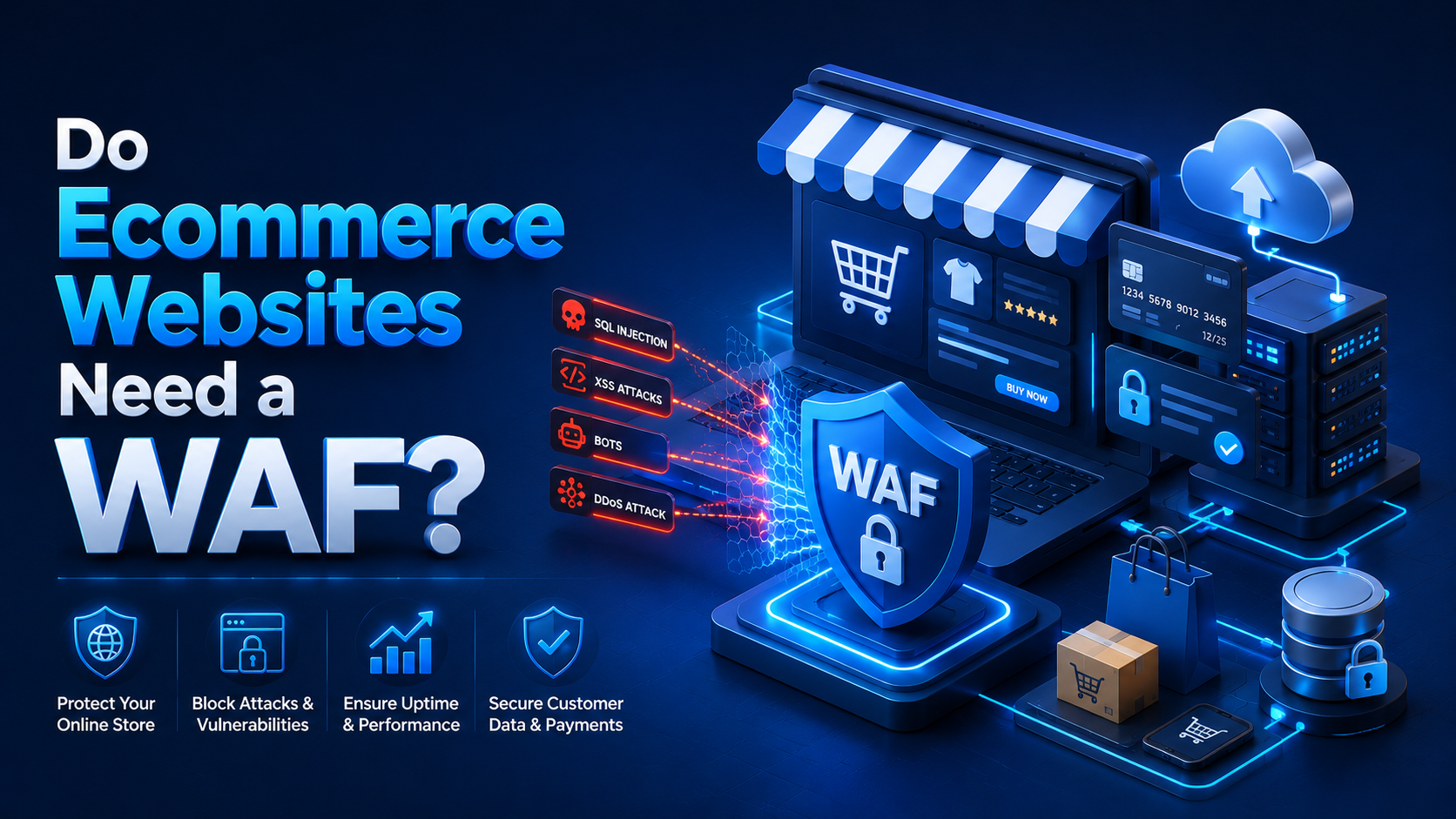
Ecommerce websites process customer accounts, online payments, APIs and other interactive features, which makes them attractive targets for cyberattacks. For many businesses, implementing a web application firewall (WAF) is an effective way to protect these internet-facing applications and reduce the risk of application-layer attacks.
Unlike a traditional firewall, which protects the wider network, a WAF inspects HTTP and HTTPS requests before they reach the website. This helps identify and block malicious traffic targeting checkout pages, login forms, customer accounts and APIs.
Whether every ecommerce website needs a WAF depends on factors, such as the platform, level of customisation and the sensitivity of the data being processed. This guide explains how a WAF works, what it protects and when it makes sense to invest in one.
What Is a WAF for Ecommerce?
A Web Application Firewall (WAF) is a security layer that sits between users and an ecommerce website, inspecting HTTP and HTTPS requests before they reach the application.
Rather than simply allowing or blocking network traffic, a WAF analyses the content and behaviour of web requests to determine whether they appear legitimate or malicious. If suspicious activity is detected, it can block, challenge, monitor or log the request before it reaches the application.
For an ecommerce website, this includes traffic sent to areas, such as:
-
Product pages
-
Search functionality
-
Login and registration forms
-
Shopping carts
-
Checkout pages
-
Customer accounts
-
Admin portals
-
API endpoints
-
Contact forms
-
Discount and promotional code fields
The goal is simple: prevent harmful requests from reaching the application while allowing genuine customers to use the website normally.
Why Ecommerce Websites Are Common Targets
Ecommerce websites are common targets because they combine valuable customer data with revenue-generating functionality.
Even when a business doesn't store payment card details directly, an online store may still process customer information, login credentials, addresses, order histories, discount rules, APIs and third-party integrations. Every one of these components presents a potential opportunity for attackers.
Common motives include:
-
Stealing customer account credentials
-
Testing compromised passwords
-
Exploiting checkout or coupon systems
-
Scraping product and pricing information
-
Targeting vulnerable plugins or custom code
-
Attacking login pages
-
Abusing APIs
-
Disrupting sales during busy trading periods
Because ecommerce websites are publicly accessible, they face constant automated scanning and probing for weaknesses. A WAF helps reduce this exposure by inspecting requests before they reach the application.
How a WAF Protects an Ecommerce Website
A WAF protects the parts of an ecommerce website that accept, process or respond to user requests. This helps reduce the risk of attacks targeting customer interactions, application logic and APIs.
Checkout Pages
Checkout is one of the most valuable parts of an ecommerce website because it directly affects revenue. A WAF helps identify suspicious requests, malformed inputs and attempts to manipulate checkout processes before they reach the application.
Login and Customer Accounts
Customer accounts are frequent targets for credential stuffing, brute-force attacks and automated login attempts. A WAF can identify abnormal traffic patterns and help reduce unauthorised access attempts.
Web Forms
Contact forms, registration forms and other user input fields can be exploited to deliver malicious payloads. A WAF helps inspect submitted data and block requests associated with attacks such as SQL injection or cross-site scripting (XSS).
APIs
Modern ecommerce platforms rely heavily on APIs for payments, inventory management, shipping providers, mobile applications and third-party integrations.
A WAF or web application and API protection solution can inspect API traffic and help detect malformed requests, suspicious behaviour and attempts to abuse exposed endpoints.
Admin Portals
Administrative interfaces control products, pricing, orders, customer information and store settings, which makes them more vulnerable to targeted attacks.
A WAF adds another layer of protection by monitoring requests to these areas and helping prevent malicious traffic from reaching administrative functions.
Common Threats a WAF Can Help Reduce
While a WAF is not a complete security solution, it provides valuable protection against many common application-layer threats, including:
-
SQL injection
-
Cross-site scripting (XSS)
-
Credential stuffing
-
Bad bots
-
API abuse
-
Malicious automated traffic
-
Exploitation of known application vulnerabilities
Combined with secure development, regular updates and strong access controls, a WAF significantly reduces the risk posed by these attacks.
When Does an Ecommerce Website Need a WAF?
Not every ecommerce website has the same security requirements. The need for a WAF depends on factors, such as the platform, hosting environment, level of customisation and the sensitivity of the data being processed.
While some hosted platforms include built-in security features, businesses should understand what those protections cover and where additional safeguards may be needed. A WAF becomes increasingly valuable as an ecommerce website grows in complexity, handles more customer data or relies on custom functionality.
Shopify
Hosted platforms, such as Shopify, include platform-level security designed to protect the underlying infrastructure. However, businesses using custom apps, third-party integrations, APIs or unique checkout experiences may still benefit from the additional protection a WAF provides.
WooCommerce
WooCommerce websites often require more direct security management because they rely on WordPress, plugins, themes and hosting configurations chosen by the business. A WAF can help reduce the risk of attacks targeting vulnerabilities in plugins, custom code or exposed web applications.
Magento
Magento powers many feature-rich ecommerce websites that process large volumes of customer data and transactions. Because Magento stores are often highly customised and integrated with external services, a WAF provides an additional layer of protection against application-layer attacks.
Custom Ecommerce Websites
Custom-built ecommerce platforms offer flexibility but also introduce unique security considerations. Custom code, APIs, integrations and bespoke checkout processes can increase the attack surface, making a WAF an important part of a layered security strategy.
Payment Security
A WAF is not a replacement for payment security or compliance requirements. Secure payment processing depends on factors, such as the payment gateway, hosting environment, application design, access controls and ongoing security management.
However, checkout pages and payment workflows are common targets for attackers. A WAF helps protect the web application layer surrounding these transactions by inspecting requests before they reach the application.
As a general guide, a WAF should be strongly considered if your ecommerce website:
-
Accepts online orders
-
Supports customer accounts
-
Includes checkout or payment workflows
-
Uses APIs or third-party integrations
-
Handles sensitive customer information
-
Relies on custom development
-
Experiences high traffic volumes or frequent bot activity
-
Generates significant business revenue
The more important your ecommerce website is to your business, the stronger the case for deploying a WAF.
Do You Still Need a Firewall?
Yes. A WAF complements a firewall but does not replace it.
A traditional firewall protects the wider network by controlling traffic between trusted and untrusted environments. It helps secure users, devices, servers, VPN connections and network infrastructure.
A WAF focuses on the ecommerce application itself, inspecting HTTP and HTTPS requests to detect and block attacks targeting checkout pages, customer accounts, APIs and other web-facing features.
For many ecommerce businesses, using both provides stronger protection through a layered security approach.
For example, in a Fortinet environment:
-
FortiGate protects the network, users and internet traffic.
-
FortiWeb protects web applications and APIs.
Together, they help secure both the infrastructure and the ecommerce platform.
Can a WAF Stop Every Attack?
No. A WAF is an important security control, but it is not a complete cybersecurity solution.
While it helps identify and block many application-layer attacks, it cannot replace secure development practices, software updates, strong authentication, malware protection, backups or ongoing monitoring.
For the best protection, a WAF should form part of a broader security strategy that also includes:
-
Multi-factor authentication (MFA)
-
Regular software and plugin updates
-
Secure hosting
-
Vulnerability management
-
Strong access controls
-
Monitoring and logging
-
Reliable backup and recovery processes
Layering these controls helps reduce risk and improves your ability to detect, prevent and recover from security incidents.
FortiWeb for Ecommerce
For businesses using Fortinet solutions, FortiWeb is the dedicated web application firewall designed to protect ecommerce websites, customer portals and APIs. It helps inspect web traffic, identify application-layer threats and reduce the risk of attacks targeting internet-facing applications.
FortiWeb can also work alongside FortiGate as part of a layered security model. While FortiGate protects the wider network and manages traffic entering the environment, FortiWeb secures the ecommerce application itself.
For FortiSecure customers, this aligns with broader security solutions, including FortiGate, FortiWeb, Virtual Appliances, FortiSecure Edge and FortiSecure Business Continuity.
Final Thoughts
Many ecommerce websites benefit from a WAF because they process customer information, support online transactions and expose business-critical applications to the internet. While a traditional firewall remains essential for protecting the wider network, it does not provide the same level of application-layer protection as a WAF.
If your ecommerce website relies on customer accounts, checkout workflows, APIs or custom functionality, deploying a WAF can help reduce security risks and strengthen your overall cybersecurity posture. For businesses running revenue-critical online stores, a WAF is best viewed as one part of a layered security strategy rather than a standalone solution.
FAQs
Do ecommerce websites need a WAF?
Many ecommerce websites benefit from a WAF, particularly if they support customer logins, checkout pages, APIs, customer accounts or custom ecommerce functionality.
What does a WAF do for an online store?
A WAF inspects HTTP and HTTPS requests before they reach the ecommerce application. It helps identify and block malicious traffic targeting features, such as checkout pages, login forms and APIs.
Is a firewall enough for an ecommerce website?
Not always. A firewall protects the network, while a WAF protects the ecommerce application. Businesses with customer-facing websites often benefit from using both.
Does Shopify need a WAF?
Shopify includes platform-level security, but businesses using custom apps, integrations, APIs or unique checkout functionality may still benefit from the additional protection a WAF provides.
Does WooCommerce need a WAF?
WooCommerce websites often rely on plugins, themes and self-managed hosting, making a WAF a valuable layer of protection against application-layer attacks.
Can a WAF protect checkout pages?
Yes. A WAF helps inspect requests sent to checkout pages, reducing the risk of malicious traffic reaching the application.
Is FortiWeb suitable for ecommerce security?
Yes. FortiWeb is Fortinet's web application firewall designed to help protect ecommerce websites, customer portals, APIs and other internet-facing applications.