Web applications have become essential to how many businesses operate, from customer portals and ecommerce stores to SaaS platforms and APIs. As these applications handle more sensitive data and online transactions, protecting them from cyber threats becomes increasingly important.
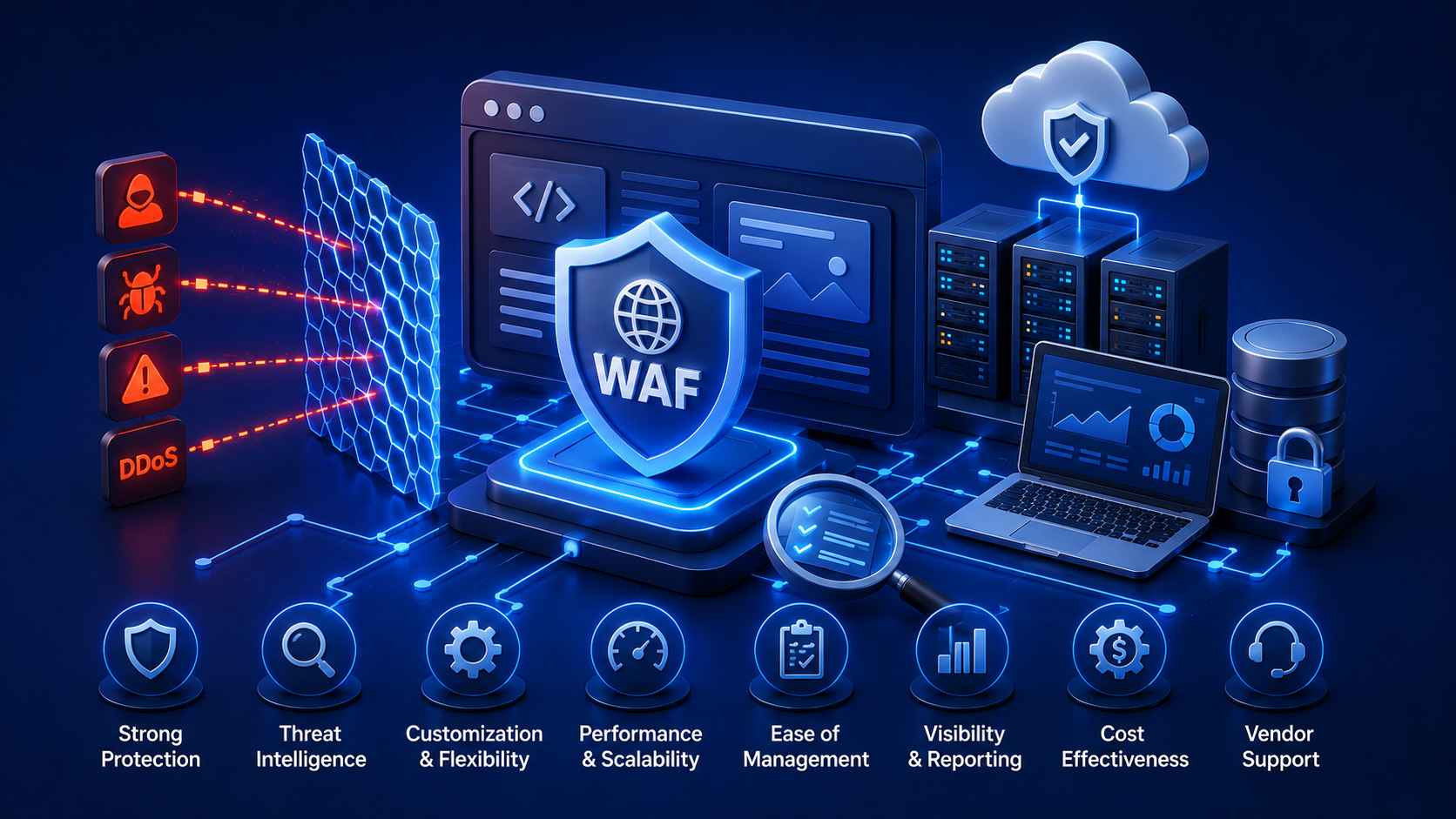
Choosing the right web application firewall (WAF) starts with understanding what you need to protect. The right solution should match your applications, APIs and business risks while providing strong application-layer security without affecting performance or legitimate users.
This guide explains the key factors to consider when comparing WAF solutions, from security capabilities and deployment options to performance, management and integration with your existing security environment.
Start With What You Need to Protect
Before comparing WAF solutions, identify what you actually need to protect.
A simple business website has very different security requirements from an ecommerce store, SaaS platform, customer portal or API-driven application. Understanding your public-facing assets helps ensure you choose a solution that matches your business risks.
Start by identifying assets, such as:
-
Main website
-
Customer login areas
-
Admin portals
-
Ecommerce checkout
-
Payment-related workflows
-
Online forms
-
Booking systems
-
APIs
-
Mobile app backends
-
Partner portals
-
Cloud-hosted web applications
The more critical these applications are to your business, the more important application-layer protection becomes.
Evaluate the Security Features
When comparing WAF solutions, focus on the security capabilities that best protect your applications without disrupting legitimate users.
Protection Against Common Web Attacks
A good WAF should defend against the most common application-layer threats by analysing how requests interact with the application.
Key protections include:
-
SQL injection
-
Cross-site scripting (XSS)
-
File inclusion attacks
-
Cookie tampering
-
Malicious request blocking
-
Application-layer DDoS attacks
-
Known vulnerability exploitation
-
Session and login abuse
-
Suspicious file uploads
-
API abuse
Unlike traditional network attacks, these threats are often hidden inside legitimate-looking web requests. An effective WAF should be able to identify malicious behaviour before it reaches the application.
API Security
APIs are now a critical part of many websites, mobile applications and cloud services, which makes API protection an essential WAF capability.
Look for features, such as:
-
API discovery
-
API schema validation
-
Suspicious API request detection
-
Authentication abuse monitoring
-
Rate limiting
-
Protection against malformed requests
-
Bot and automation control
-
API traffic visibility
This is particularly important for ecommerce, SaaS, financial services, healthcare and other organisations that exchange sensitive information through APIs.
For Fortinet environments, FortiWeb is designed to provide both web application and API protection.
Bot Protection
Not all bots are harmful, but malicious bots can create significant security and business risks.
A capable WAF should help detect and control activities, such as:
-
Credential stuffing
-
Fake account creation
-
Content scraping
-
Checkout abuse
-
Inventory hoarding
-
Form spam
-
Login attacks
-
API abuse
-
Automated vulnerability scanning
The goal is to distinguish legitimate bots, such as search engine crawlers, from malicious automation without affecting SEO or normal business operations.
HTTPS Inspection
Because most web traffic is encrypted, a WAF must be able to inspect HTTPS traffic without compromising performance.
When evaluating a solution, consider:
-
HTTPS inspection capabilities
-
Certificate management
-
Performance impact
-
Support for modern TLS standards
-
Compatibility with your hosting environment and compliance requirements
Without HTTPS inspection, malicious activity hidden within encrypted traffic may go undetected.
Compare Deployment, Performance and Scalability
The right deployment model depends on your infrastructure, hosting environment and future growth plans.
Deployment Options
Common WAF deployment models include:
|
Deployment Type |
Best For |
|
Hardware appliance |
Businesses requiring on-premises control |
|
Virtual appliance |
Private cloud, virtual environments and data centres |
|
Cloud WAF |
Cloud-first organisations and distributed applications |
|
SaaS-managed WAF |
Businesses seeking simplified management |
|
Hybrid deployment |
Organisations operating both cloud and on-premises environments |
Choose a deployment model that supports your current infrastructure while allowing room for future expansion.
Performance and Scalability
A WAF sits directly in the path of web traffic, making performance an important consideration.
Before selecting a solution, ask:
-
Can it support current and future traffic volumes?
-
Does it provide high availability?
-
Can it scale as applications grow?
-
Will it affect page load times or API response times?
-
How does it handle traffic spikes?
-
What happens during a failover?
This is particularly important for ecommerce, SaaS platforms and customer-facing applications where downtime or poor performance can directly affect revenue.
Consider Day-to-Day Management
Choosing the right WAF is only part of the process. Ongoing management is equally important to ensure it continues protecting your applications without disrupting legitimate users.
Reducing False Positives
False positives occur when legitimate users are mistakenly blocked or challenged.
This can affect:
-
Checkout processes
-
Customer logins
-
Contact forms
-
Search functionality
-
APIs
-
Customer portals
Look for capabilities, such as:
-
Learning mode
-
Behaviour-based detection
-
Custom security policies
-
Application profiling
-
Detailed logging
-
Safe testing before enforcement
-
Easy rule tuning
The objective is to stop malicious traffic while allowing genuine users to complete normal activities.
Reporting and Visibility
A WAF should provide clear visibility into application traffic and security events.
Useful reporting includes:
-
Attack types
-
Blocked requests
-
Source locations
-
Targeted URLs
-
API activity
-
Bot activity
-
Policy violations
-
Risk trends
-
Application health
These insights help security teams understand what the WAF is blocking, identify emerging threats and refine security policies over time.
Ongoing Management
A WAF requires regular monitoring, policy updates and ongoing maintenance. Before selecting a solution, determine who will be responsible for managing it.
This may include:
-
Internal IT teams
-
Security teams
-
Managed service providers
-
Fortinet specialists
-
Hosting providers
-
External security partners
The most effective WAF is one your organisation has the resources to configure, monitor and maintain properly.
Consider Compliance and Integration
If your applications handle customer information, payment workflows, healthcare records or other sensitive data, compliance and integration should form part of your evaluation.
A WAF can support compliance by helping organisations:
-
Protect web applications
-
Monitor suspicious activity
-
Enforce security policies
-
Maintain audit records
-
Improve visibility into application traffic
While a WAF does not guarantee compliance on its own, it can strengthen the security controls required by many regulatory frameworks.
It's also important to consider how the WAF integrates with your broader security environment.
For organisations already using Fortinet solutions, FortiWeb can integrate with products, such as FortiGate, FortiAnalyzer, FortiSIEM and FortiSOAR. It helps security teams correlate events, streamline monitoring and improve incident response.
A WAF delivers greater value when it works alongside the rest of your security stack rather than operating as an isolated security tool.
FortiWeb as a WAF Option
FortiWeb is Fortinet's web application firewall and API protection solution, designed to protect websites, web applications and APIs from known and emerging threats.
For organisations already using Fortinet technologies, FortiWeb integrates with products, such as FortiGate, FortiAnalyzer and FortiSIEM, to provide broader visibility and coordinated security operations. It supports multiple deployment models, including hardware, virtual and cloud environments, which makes it suitable for organisations with a range of infrastructure requirements.
For FortiSecure customers, FortiWeb complements solutions, such as FortiGate, Virtual Appliances, Security Operations & Analytics and FortiSecure Business Continuity.
Web Application Firewall Buying Checklist
Before choosing a WAF, ask:
-
Which websites, applications and APIs need protection?
-
Which application-layer threats are most relevant to the business?
-
Does the WAF support API security, bot protection and HTTPS inspection?
-
Can it minimise false positives without disrupting legitimate users?
-
Does it provide useful reporting and monitoring?
-
Will it scale as traffic and applications grow?
-
Does it support your preferred deployment model?
-
Can it integrate with your existing firewall, SIEM and security tools?
-
Does your team have the resources to manage and maintain it?
Final Thoughts
Choosing a web application firewall should start with your business requirements rather than a product feature list. The right WAF should protect your websites, web applications and APIs against common application-layer threats while fitting your infrastructure, performance requirements and existing security environment.
For organisations using Fortinet technologies, FortiWeb provides web application and API protection that integrates with the broader Fortinet Security Fabric.
A traditional firewall protects the network. A WAF protects the applications your customers interact with every day. Businesses that depend on both should consider both as part of a layered cybersecurity strategy.
FAQs
What is a web application firewall?
A web application firewall is a security tool that inspects HTTP and HTTPS traffic to protect websites, web applications and APIs from application-layer attacks.
How do I choose a web application firewall?
Start by identifying the applications and APIs you need to protect. Next, compare attack protection, API security, bot defence, false positive handling, reporting, deployment options, scalability and integration with your existing security stack.
What features should a WAF have?
A good WAF should include protection against SQL injection, cross-site scripting, malicious requests, API abuse, bot activity, suspicious uploads, cookie tampering and application-layer attacks. It should also offer clear reporting and policy tuning.
Do I need a WAF if I already have a firewall?
Yes, you need a WAF if your business runs public-facing web applications, portals, ecommerce systems or APIs. A firewall protects the network, while a WAF protects the application layer.
Is FortiWeb a web application firewall?
Yes. FortiWeb is Fortinet’s web application firewall and API protection solution.
Is a cloud WAF better than an appliance WAF?
It depends on your environment. Cloud WAFs can be easier for cloud-first applications, while appliance or virtual WAFs may suit businesses that need more control over deployment and data handling.
What is the best WAF for ecommerce?
The best WAF for ecommerce should protect checkout flows, login pages, forms, APIs, payment-related traffic, bots and application-layer attacks without blocking legitimate customers.