
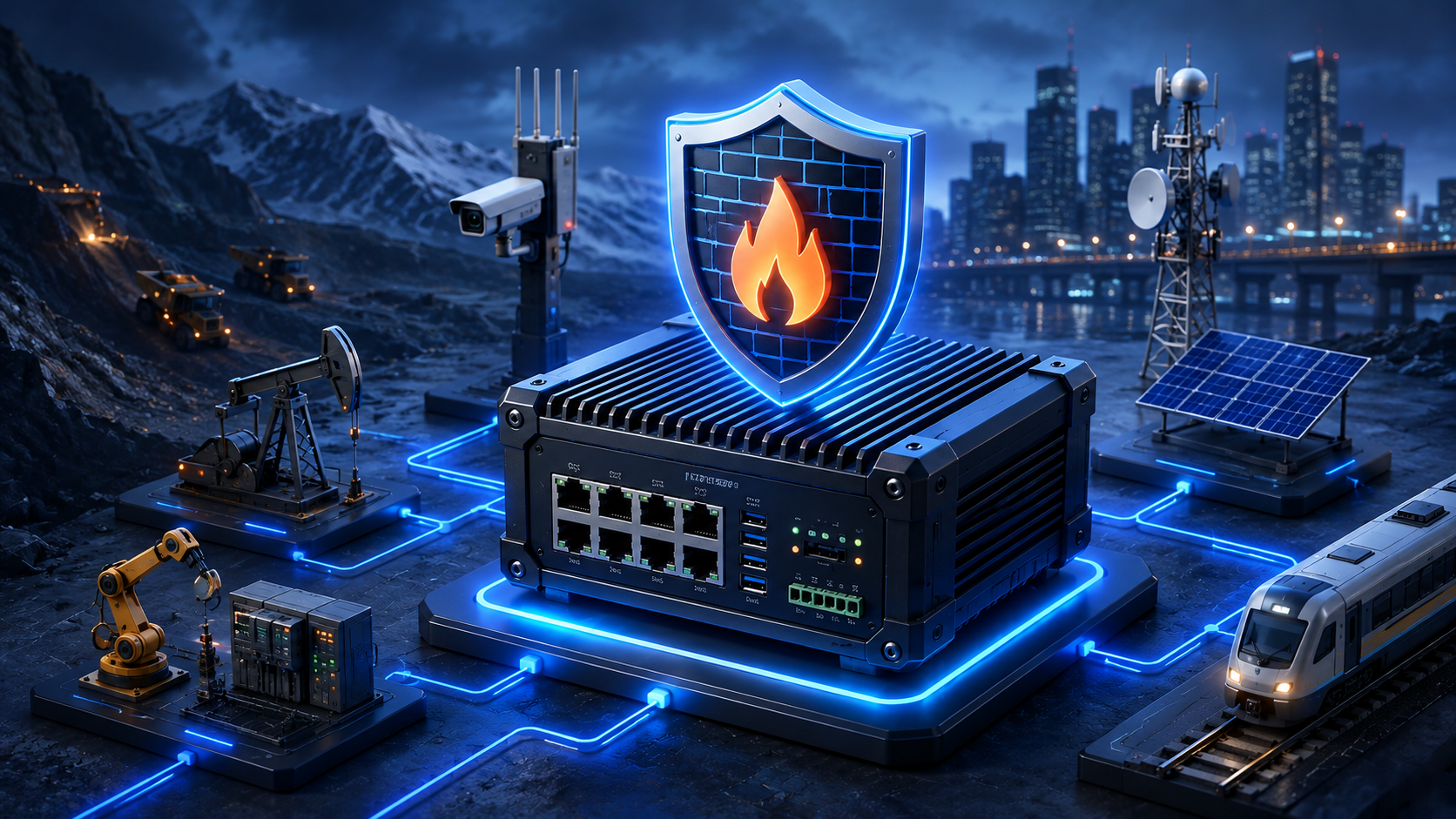
Industrial networks often operate in environments where standard networking equipment may not be suitable. Factories, substations, transport systems, utilities and remote facilities can expose hardware to extreme temperatures, dust, vibration, electrical interference and other challenging conditions.
A rugged firewall is specifically designed for these environments. It combines enterprise-grade firewall security with industrial-grade hardware, helping protect operational technology (OT) networks while continuing to operate reliably in harsh physical conditions.
Unlike a standard office firewall, a rugged firewall is built to support critical infrastructure and industrial operations where reliability, uptime and secure connectivity are essential. This guide explains what a rugged firewall is, how it works and when businesses should consider deploying one.
What Is a Rugged Firewall?
A rugged firewall is a security appliance designed to protect industrial and operational technology (OT) networks while withstanding harsh operating environments.
Where a standard firewall is typically installed in offices, server rooms or data centres, a rugged firewall is engineered for locations, such as production facilities, substations, warehouses, transport systems, energy sites and remote industrial installations.
These environments often experience conditions that standard networking equipment is not designed to handle, including:
-
Extreme temperatures
-
Dust and moisture
-
Vibration from heavy machinery
-
Electrical interference
-
Limited installation space
-
Continuous operating requirements
In addition to providing network security, rugged firewalls help organisations securely connect industrial systems, remote sites and business networks without compromising reliability.
They are commonly deployed to protect:
-
Industrial control systems (ICS)
-
SCADA environments
-
Manufacturing equipment
-
Utility and energy networks
-
Remote industrial sites
-
Warehouses and logistics facilities
-
Industrial IoT (IIoT) devices
-
Building automation systems
Rugged firewalls are often referred to as industrial firewalls. While both protect industrial and OT networks, a rugged firewall is specifically built to operate reliably in demanding physical environments.
Why Rugged Firewalls Matter
Industrial environments have changed significantly over the past decade.
Systems that once operated in isolation are now commonly connected to business networks, cloud platforms, remote monitoring tools and third-party vendors. While this improves operational efficiency and visibility, it also increases exposure to cyber threats.
Unlike traditional IT environments, operational technology prioritises uptime, safety and continuous operation. Taking critical systems offline for maintenance or recovering from a cyber incident can disrupt production, impact essential services and create significant financial or operational consequences.
A rugged firewall helps reduce these risks by controlling communication between industrial assets, business networks, remote users and external connections. It also supports network segmentation and helps prevent threats from moving between different parts of the environment.
For organisations operating critical infrastructure, manufacturing facilities or remote industrial sites, rugged firewalls have become an important component of modern OT cybersecurity strategies.
How a Rugged Firewall Works
A rugged firewall acts as a security gateway for industrial network traffic. It inspects communications between devices, applications and network zones, then applies security policies to determine which traffic should be allowed, monitored or blocked.
Industrial networks present unique security challenges because they often contain specialised equipment, legacy systems and operational technologies that require secure connectivity without disrupting critical processes.
Protecting Industrial Networks
A rugged firewall helps secure communications between:
-
Industrial control systems
-
PLCs and controllers
-
SCADA systems
-
Human-machine interfaces (HMIs)
-
Remote terminal units (RTUs)
-
Industrial IoT devices
-
Business IT networks
-
Remote maintenance connections
By filtering traffic between these systems, organisations can reduce the risk of unauthorised access, malware and lateral movement across the network.
Depending on the deployment, a rugged firewall may also provide capabilities, such as:
-
Traffic filtering
-
Network segmentation
-
Secure VPN connectivity
-
Intrusion prevention
-
Application control
-
Threat protection
-
Logging and monitoring
-
Centralised security management
The exact configuration depends on the industrial environment, connected equipment and operational requirements.
Supporting OT Security
Operational technology environments have different priorities from traditional IT networks. Many industrial devices cannot be patched or replaced as frequently because they support critical production processes or essential infrastructure.
A rugged firewall helps improve security without requiring changes to every industrial device. By controlling traffic between OT systems, business networks and remote connections, it provides an additional layer of protection around critical assets.
It also supports defence-in-depth by helping organisations:
-
Separate IT and OT networks
-
Control vendor and remote access
-
Protect legacy industrial systems
-
Monitor communications between security zones
-
Reduce exposure to unauthorised access
-
Support secure remote maintenance
Rather than replacing existing OT security controls, a rugged firewall strengthens the overall security architecture by protecting the network layer.
Rugged Firewall vs Standard Firewall
Both rugged and standard firewalls perform the same core function of inspecting and controlling network traffic. The key difference is the environment they are designed to operate in.
|
Area |
Standard Firewall |
Rugged Firewall |
|
Best environment |
Offices, data centres and server rooms |
Industrial sites, OT environments and outdoor locations |
|
Physical design |
Built for controlled environments |
Built to withstand heat, cold, vibration, dust and electrical interference |
|
Primary purpose |
Business network security |
Industrial and OT network security |
|
Typical deployment |
Office networks and branch locations |
Factories, substations, warehouses, utilities and manufacturing facilities |
|
Fortinet example |
FortiGate |
FortiGate Rugged |
A rugged firewall is not inherently more secure than a standard firewall. Instead, it is designed to deliver enterprise-grade network protection in environments where standard hardware may not operate reliably.
When Does a Business Need a Rugged Firewall?
A business should consider a rugged firewall when it needs reliable network security in environments where standard networking equipment may not be suitable.
This is particularly important for organisations operating industrial facilities, remote infrastructure or operational technology (OT) environments where uptime and environmental conditions are critical.
A rugged firewall may be the right choice if your environment includes:
-
Extreme temperatures
-
Dust or moisture
-
Heavy vibration from machinery
-
Electrical or radio frequency interference
-
Limited installation space
-
Remote or difficult-to-access locations
-
Critical uptime requirements
-
Industrial control systems or OT networks
-
Outdoor or semi-outdoor installations
It also becomes increasingly important when industrial systems are connected to business networks, cloud platforms, remote users or third-party vendors. As connectivity increases, so does the need to control and monitor traffic between different parts of the environment.
Common Industry Use Cases
Manufacturing
Manufacturing facilities use rugged firewalls to segment production networks, secure industrial equipment, support remote maintenance and reduce the risk of unauthorised access affecting operations.
Utilities and Energy
Power generation, substations, water treatment facilities and energy infrastructure rely on rugged firewalls to help secure critical systems while maintaining continuous service availability.
Transport and Logistics
Transport networks, rail systems, warehouses and logistics hubs often operate in demanding environments where rugged hardware provides reliable protection for connected operational systems.
Oil, Gas and Mining
Industrial sites in the resources sector frequently experience harsh environmental conditions and rely on rugged firewalls to secure remote facilities, field equipment and industrial communications.
Smart Buildings and Critical Infrastructure
Building management systems, access control platforms, surveillance networks and other connected infrastructure can benefit from rugged firewalls where environmental durability and secure connectivity are both essential.
FortiGate Rugged
For organisations using Fortinet solutions, FortiGate Rugged extends next-generation firewall protection into industrial and operational technology environments. Designed for harsh operating conditions, it combines industrial-grade hardware with advanced security capabilities, including traffic inspection, network segmentation, secure connectivity and threat protection.
Businesses that already use FortiGate across their corporate network can also deploy FortiGate Rugged at industrial sites to maintain consistent security policies across both IT and OT environments.
For FortiSecure customers, FortiGate Rugged integrates with the wider FortiSecure Industrial portfolio, supporting industrial cybersecurity strategies that protect connected facilities, critical infrastructure and remote operations.
Does a Rugged Firewall Replace OT Security?
No. A rugged firewall is an important part of OT security, but it is only one layer of a broader cybersecurity strategy. While it helps secure network traffic and control communications between industrial systems, it does not replace other essential security measures, such as:
-
Asset discovery and visibility
-
Secure remote access
-
Endpoint protection where appropriate
-
Network monitoring
-
Vulnerability management
-
Access control
-
Security monitoring and incident response
A defence-in-depth approach combines these controls to reduce cyber risk while maintaining the availability and reliability that industrial environments require.
Final Thoughts
A rugged firewall is purpose-built for industrial and operational technology environments where standard networking equipment may not provide the durability or reliability required. It combines enterprise-grade firewall capabilities with industrial-grade hardware to help organisations protect manufacturing facilities, utilities, transport systems, energy infrastructure and other critical environments while supporting secure connectivity and network segmentation.
For businesses operating OT networks or industrial sites, a rugged firewall is an important part of a layered cybersecurity strategy. In Fortinet environments, FortiGate Rugged extends enterprise firewall protection into harsh operating conditions, helping organisations secure both their infrastructure and operational technology.
FAQs
What is a rugged firewall?
A rugged firewall is a firewall designed for industrial, remote and harsh operating environments. It provides network security while using hardware built to withstand conditions, such as extreme temperatures, dust, vibration and electrical interference.
What is the difference between a rugged firewall and a standard firewall?
A standard firewall is designed for offices and data centres, while a rugged firewall is engineered for industrial environments where environmental durability and continuous operation are essential.
What is FortiGate Rugged?
FortiGate Rugged is Fortinet's industrial firewall series designed for operational technology and harsh environments. It combines next-generation firewall capabilities with hardware built for demanding industrial conditions.
Who needs a rugged firewall?
Businesses operating manufacturing facilities, utilities, substations, warehouses, transport systems, energy infrastructure, mining operations or other OT environments should consider deploying rugged firewalls.
Is a rugged firewall used for OT security?
Yes. Rugged firewalls are commonly used to support OT security by segmenting industrial networks, controlling remote access and helping protect critical operational systems.
Does a rugged firewall replace a standard firewall?
Not necessarily. Many organisations use standard FortiGate firewalls in office environments and FortiGate Rugged appliances at industrial or remote sites, applying the most appropriate hardware for each environment.