Cyber threats rarely announce themselves with a single warning. More often, they leave small clues scattered across firewalls, endpoints, servers, cloud platforms and user activity. The challenge is connecting those clues before they become a serious security incident.
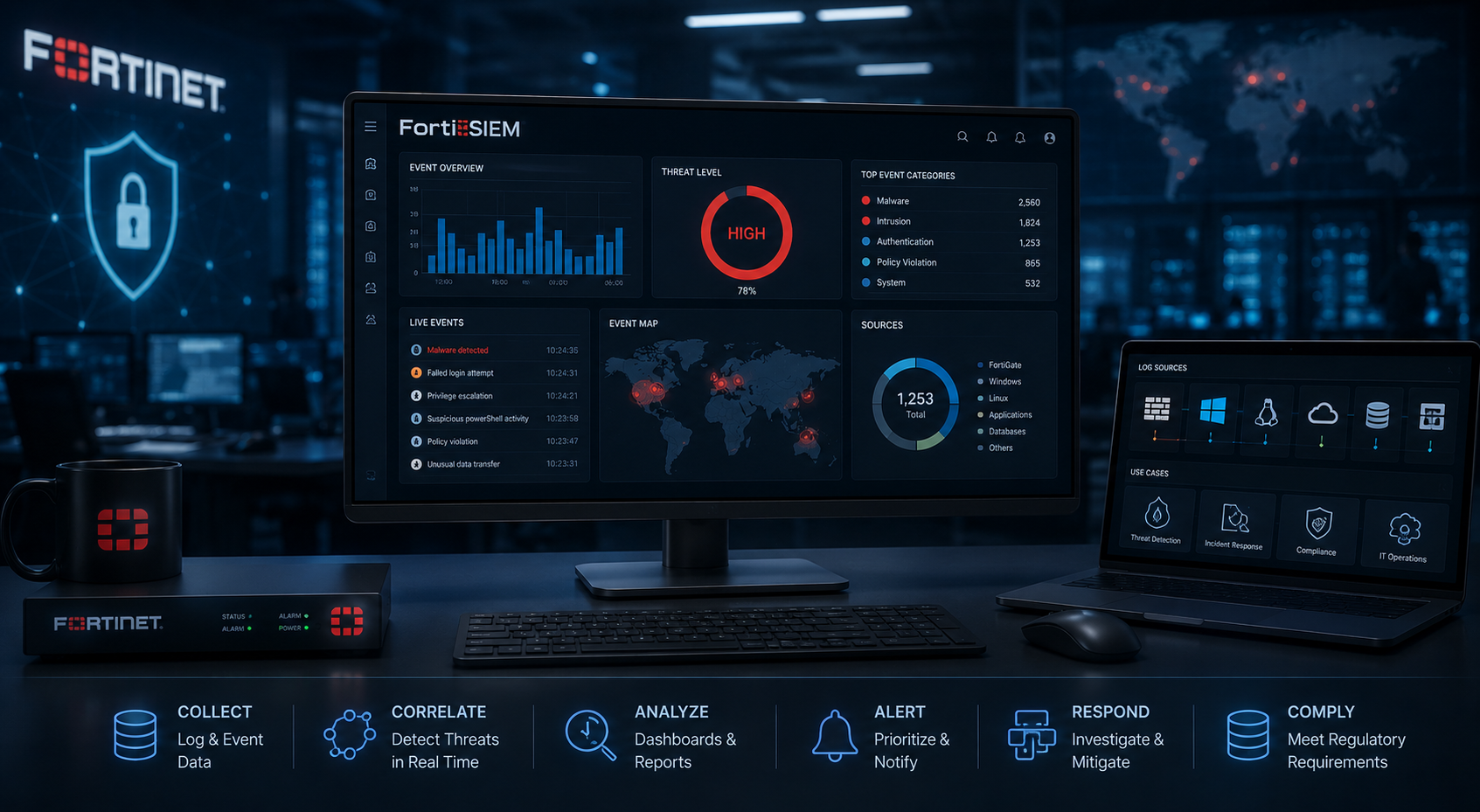
FortiSIEM is Fortinet's Security Information and Event Management (SIEM) platform designed to bring security data together in one place. It collects, analyses and correlates events from across your IT environment, helping security teams detect threats, investigate incidents and gain greater visibility into their networks, systems and users.
For organisations using Fortinet solutions, such as FortiGate, FortiAnalyzer, FortiEDR and FortiSOAR, FortiSIEM can play a central role in strengthening security operations and improving threat monitoring across the business. In this article, we'll look at what FortiSIEM does, its key capabilities and when organisations should consider using it.
What Is FortiSIEM?
FortiSIEM is a Security Information and Event Management (SIEM) platform from Fortinet that helps organisations collect, analyse and correlate security and operational data across their IT environment.
Instead of reviewing logs from different tools separately, FortiSIEM centralises this information into a single platform. This allows security teams to identify threats, investigate incidents and understand activity across networks, users, devices, applications and cloud services.
At its core, FortiSIEM is designed to improve visibility and help teams respond to security events more effectively.
Key capabilities include:
-
Collecting logs and event data from multiple sources
-
Normalising different data formats into a unified view
-
Correlating events across systems
-
Detecting suspicious activity
-
Supporting incident investigation
-
Assisting with compliance reporting
-
Improving SOC and NOC visibility
What Does SIEM Mean?
SIEM stands for Security Information and Event Management.
It combines two core functions:
-
Security Information refers to the collection of logs and data from systems, such as firewalls, endpoints, servers, applications and cloud platforms.
-
Event Management refers to analysing that data, identifying patterns and generating alerts when suspicious activity is detected.
A SIEM does not replace security tools like firewalls or endpoint protection. Instead, it aggregates and correlates the data they produce to give a more complete picture of what is happening.
For example, a failed login attempt, unusual network traffic and endpoint behaviour may not seem significant individually. When combined, they can indicate a potential security incident.
Why FortiSIEM Matters
Modern IT environments generate large volumes of data across multiple systems, including cloud platforms, on-premises infrastructure, remote users and security tools. Without centralised visibility, important signals can be missed or delayed.
FortiSIEM addresses this by consolidating security and operational data into a single platform. This allows teams to better understand activity across their environment and respond more efficiently to potential threats.
It helps organisations:
-
Improve visibility across security events and infrastructure
-
Detect threats faster through event correlation
-
Reduce alert fatigue from multiple tools
-
Centralise monitoring and log management
-
Support compliance and audit requirements
-
Improve investigation speed and accuracy
-
Strengthen overall security operations
Instead of working with isolated alerts, teams can see how events connect across systems.
How FortiSIEM Works
FortiSIEM operates by collecting and analysing data from across an organisation’s IT environment.
A typical flow looks like this:
-
Systems, such as firewalls, servers, endpoints, cloud platforms and applications, generate logs and events.
-
FortiSIEM collects this data from multiple sources.
-
The data is normalised into a consistent format.
-
Correlation rules and analytics identify patterns and anomalies.
-
Relevant events are grouped into alerts or incidents.
-
Security teams investigate using dashboards and contextual data.
-
Teams respond based on severity and impact.
The key value of FortiSIEM is not just data collection, but the ability to connect related events and highlight what actually matters.
Key Features of FortiSIEM
FortiSIEM includes a set of core capabilities designed to improve visibility, detection and investigation across security and operational environments.
Event Collection and Normalisation
FortiSIEM collects logs from multiple systems and standardises them so they can be analysed together, regardless of source or format.
Event Correlation
It connects related events across systems to identify patterns that may indicate suspicious activity or security incidents.
SOC and NOC Visibility
FortiSIEM supports both security and network operations teams by providing visibility into threats, performance issues and system health.
CMDB Integration
The built-in Configuration Management Database (CMDB) provides asset context, helping teams understand the importance and relationships of affected systems during investigations.
User and Entity Behaviour Analytics (UEBA)
UEBA helps detect unusual behaviour patterns, such as abnormal login locations, access patterns or system usage that may indicate compromise.
Compliance Support
FortiSIEM helps organisations meet compliance requirements by centralising logs, tracking activity and supporting audit reporting.
Need better visibility across security events, logs, users, devices and Fortinet products? Explore FortiSecure’s Security Operations & Analytics solutions or speak with our Fortinet specialists to find the right FortiSIEM setup for your environment.
Common FortiSIEM Use Cases
FortiSIEM is used across security and IT operations to improve detection, investigation and compliance outcomes in complex environments.
Threat Detection
FortiSIEM helps identify suspicious behaviour across users, devices, applications and networks.
Incident Investigation
Security teams can investigate alerts using correlated data, timelines and asset context to understand what happened.
Log Management
It centralises logs from multiple systems, which reduces the need to check individual tools separately.
Compliance Reporting
FortiSIEM supports reporting requirements by collecting and organising security data for audits and internal reviews.
Asset Visibility
It helps organisations identify and monitor devices across the environment, reducing blind spots and unmanaged systems.
FortiSIEM Comparisons and Deployment Options
In many Fortinet environments, FortiSIEM works alongside other security and deployment options depending on operational needs. Check out how FortiSIEM compares with FortiAnalyzer, FortiSOAR and its deployment models.
FortiSIEM vs FortiAnalyzer
FortiAnalyzer focuses on logging, reporting and analytics for Fortinet devices, such as FortiGate. It is best suited for organisations operating primarily within the Fortinet ecosystem.
FortiSIEM provides broader security event correlation across multiple vendors, cloud platforms and infrastructure systems.
In simple terms, FortiAnalyzer is Fortinet-focused reporting, while FortiSIEM is broader security operations visibility.
FortiSIEM vs FortiSOAR
FortiSIEM is used to detect, correlate and investigate security events. It helps teams understand what is happening across their environment.
FortiSOAR, on the other hand, focuses on automating response actions and workflows after an incident is identified.
In simple terms, FortiSIEM identifies and investigates issues, while FortiSOAR automates the response process.
FortiSIEM Cloud vs Appliance
FortiSIEM Cloud is a managed, scalable deployment option that reduces infrastructure overhead and suits distributed environments.
FortiSIEM Appliance (or on-premises/virtual deployment) provides greater control over data, infrastructure and configuration. It is often preferred in environments with strict compliance or internal hosting requirements.
In simple terms, Cloud is easier to manage, while appliance offers more control.
Who Should Consider FortiSIEM?
FortiSIEM is best suited for organisations that need greater visibility and control across their security environment.
It is particularly relevant for:
-
Businesses with multiple locations or complex infrastructure
-
Organisations using Fortinet security products
-
Teams managing hybrid or cloud environments
-
Security teams handling large volumes of alerts
-
Organisations with compliance and reporting requirements
-
MSPs and MSSPs managing multiple customer environments
-
Companies with SOC or NOC operations
As environments grow in complexity, centralised visibility becomes essential for effective monitoring and response.
Final Thoughts
FortiSIEM is a security information and event management platform designed to help organisations improve visibility, detect threats and manage security events across complex IT environments. By collecting and correlating data from across networks, endpoints, cloud services and applications, it enables security teams to identify risks more quickly and investigate incidents with greater context.
If you are dealing with fragmented monitoring tools, increasing alert volumes or limited visibility across systems, FortiSIEM provides a more centralised and structured approach to security operations.