
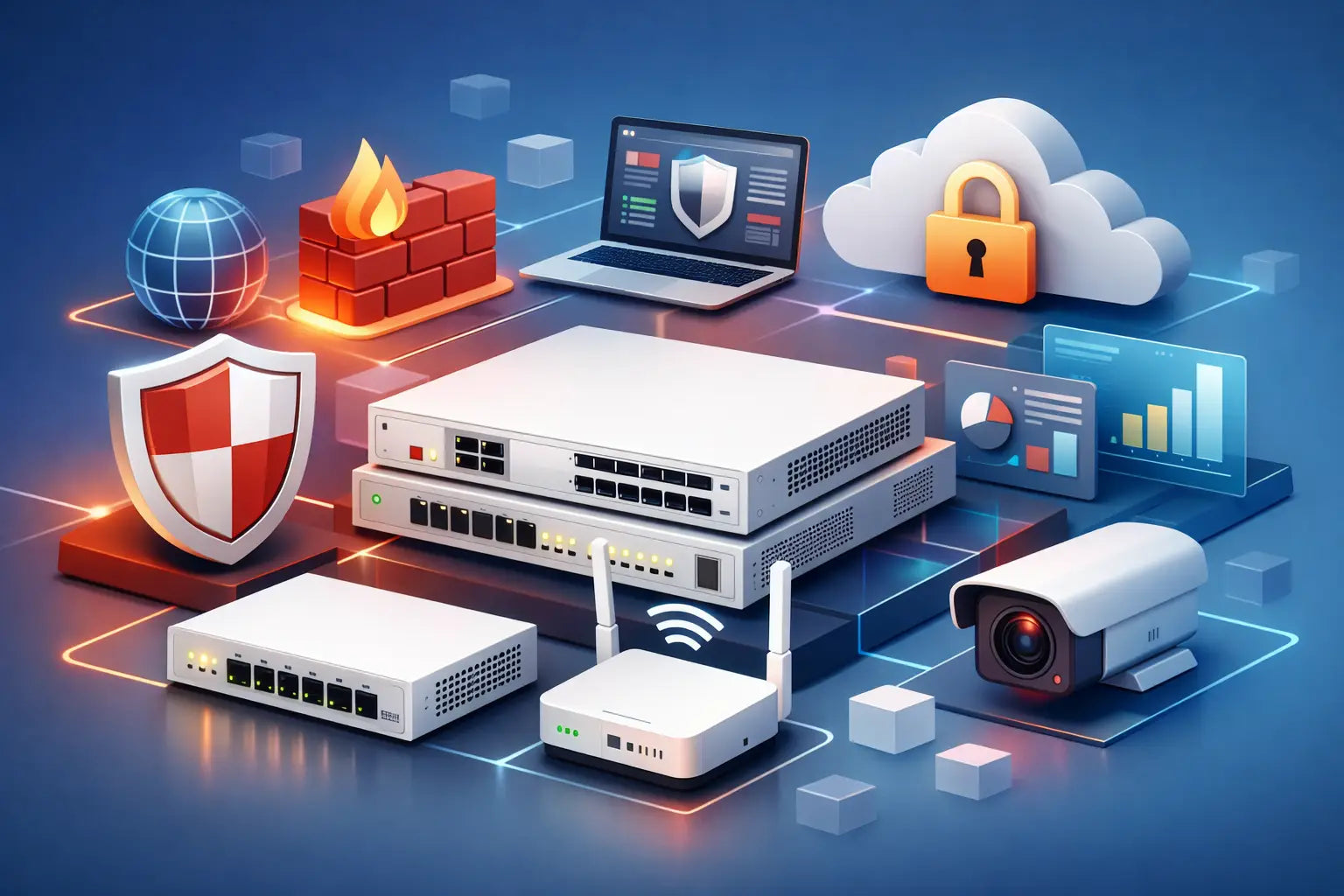
Buying Fortinet well starts with one practical question: which products solve your actual security problem without creating three more. That is where top Fortinet products explained properly becomes useful. Fortinet has a broad portfolio, but the value is not in buying the most products - it is in choosing the right parts of the platform for your network, users, cloud footprint and compliance obligations.
For most organisations, Fortinet makes the most sense when you want fewer vendors, tighter policy control and simpler day-to-day operations. The platform is built around shared visibility and coordinated enforcement, which matters if your current environment feels fragmented. If your business is managing separate tools for firewalling, switching, wireless, endpoint and remote access, Fortinet is often being considered for exactly that reason.
Top Fortinet products explained for real-world use
The easiest way to understand Fortinet is to start with the products most buyers actually deploy first. In many cases, that begins at the network edge and expands inward as requirements grow.
FortiGate - the core of most Fortinet deployments
FortiGate is Fortinet’s next-generation firewall range, and for many businesses it is the anchor product. It handles traditional firewalling, intrusion prevention, web filtering, application control, VPN, SD-WAN and a range of advanced security functions depending on the model and licensing.
For a small business, a FortiGate appliance may simply replace an ageing firewall and provide better visibility, stronger policy control and cleaner remote access. For a mid-market or enterprise environment, it often becomes the decision point for traffic moving between sites, users, internet services and cloud applications.
What makes FortiGate attractive is not just feature density. It is the balance between performance and consolidated security. Instead of stacking multiple point products around the edge, you can centralise more of that control into one platform. The trade-off is that sizing matters. Buy too small and inspection features can affect throughput. Buy too large and you may overspend on capacity you will not use for years.
FortiSwitch - secure switching that works with the firewall
FortiSwitch is Fortinet’s switching portfolio. On paper, switches are simple - they connect devices on the LAN. In practice, the security value comes from how switching, segmentation and policy enforcement are managed together.
When FortiSwitch is integrated with FortiGate, network teams gain tighter control over access policies, VLANs and port-level behaviour from a central point. That can reduce operational overhead, especially for distributed offices, schools, healthcare sites and multi-site businesses where consistency matters.
This is not always the cheapest way to buy switching if you compare hardware alone. It becomes cost-effective when central management, reduced complexity and cleaner segmentation are priorities. If your environment is stable and simple, standalone switching may be enough. If you are dealing with guest access, IoT devices, compliance zones or multiple sites, integrated switching becomes much more compelling.
FortiAP - wireless with policy consistency
FortiAP brings wireless access into the same broader security model. For organisations running separate Wi-Fi platforms, the attraction is straightforward: fewer consoles, more consistent policy and simpler deployment.
FortiAP is particularly useful when you want wireless access tied closely to user identity, network segmentation and branch rollout standards. In a growing business, that means less time spent managing disconnected systems and fewer gaps between wired and wireless policy.
The key consideration is scale and feature depth. Some highly specialised wireless environments may still prefer a dedicated best-of-breed platform with niche capabilities. But for many business networks, FortiAP delivers the right mix of coverage, control and administrative efficiency when paired with FortiGate and FortiSwitch.
The products that extend protection beyond the edge
Once the network edge is covered, most organisations start addressing users, endpoints, applications and cloud. This is where Fortinet’s wider portfolio becomes relevant.
FortiClient - endpoint protection and secure access
FortiClient is used for endpoint security, VPN and zero trust network access use cases, depending on how it is licensed and deployed. For many buyers, it starts as the remote access client for staff working from home, on the road or between offices.
Its value increases when endpoint telemetry is fed back into the wider Fortinet environment. That allows security teams to make access decisions based on device posture, not just usernames and passwords. If a device is unpatched or behaving suspiciously, policies can respond accordingly.
For smaller organisations, FortiClient can be a practical way to improve remote access hygiene without overcomplicating the stack. For larger environments, the question becomes whether its capabilities align with existing endpoint detection, identity and device management tooling. If you already have a mature endpoint platform, FortiClient may be used selectively rather than universally.
FortiEDR and FortiXDR - stronger detection and response
Where FortiClient supports endpoint access and protection, FortiEDR is aimed at deeper endpoint detection and response. It is designed to identify malicious activity, contain threats and provide response capability across endpoints.
FortiXDR expands the view further by correlating signals from multiple security layers. That is attractive for organisations trying to reduce alert fatigue and improve response times without building a full security operations function from scratch.
These products are most relevant when your risk profile is rising, your internal team is stretched or your compliance environment demands stronger monitoring. The trade-off is that detection and response tools only deliver value if they are configured, monitored and acted on properly. Buying the product is not the same as operating the outcome.
FortiMail and FortiSandbox - targeted protection for common attack paths
Email remains one of the easiest ways into a business, so FortiMail matters for organisations that want stronger filtering, anti-phishing controls and mail security management. It is particularly relevant where executive impersonation, business email compromise or attachment-based threats are a concern.
FortiSandbox adds another layer by detonating suspicious files in an isolated environment to identify malicious behaviour before it reaches users or systems. This is useful in environments that see a high volume of attachments, file transfers or targeted attacks.
Not every business needs both from day one. If your existing email security is underperforming, FortiMail may be the immediate gap to close. If your concern is advanced malware and unknown files, sandboxing may be the stronger priority.
Top Fortinet products explained for cloud and identity needs
Cloud adoption has changed what buyers expect from security platforms. Perimeter-only thinking does not hold up well when workloads, users and data are spread across multiple environments.
FortiWeb and FortiADC - protecting applications and availability
FortiWeb is Fortinet’s web application firewall, built to protect web applications and APIs from common attacks such as SQL injection, cross-site scripting and application-layer abuse. It is highly relevant for businesses exposing customer portals, payment systems, internal apps or public-facing services.
FortiADC focuses on application delivery control and load balancing. That means performance, availability and traffic distribution rather than purely threat prevention. In practical terms, organisations often consider FortiADC when application uptime is commercially critical.
These products are not mandatory for every environment. If you do not host important web applications, they may be unnecessary. If your digital services are central to revenue, customer service or internal operations, they become much harder to ignore.
FortiAuthenticator and FortiToken - identity that strengthens access control
Identity is now central to security design, especially with hybrid work and third-party access. FortiAuthenticator supports identity services, authentication workflows and integration across the Fortinet ecosystem. FortiToken adds multi-factor authentication, which is one of the simplest ways to reduce account compromise risk.
For many Australian businesses, this is less about adding another security product and more about correcting a known weakness. If remote access, privileged access or compliance obligations are part of your environment, stronger identity controls usually pay for themselves quickly.
How to choose the right Fortinet mix
The biggest mistake buyers make is treating Fortinet as a catalogue instead of a platform. You do not need every product. You need the right architecture.
If you are replacing an ageing firewall estate, FortiGate is the natural starting point. If branch standardisation and simplified LAN control are issues, FortiSwitch and FortiAP deserve serious attention. If remote work, device posture and user risk are rising, FortiClient and identity controls become more important. If you are dealing with heavier threat detection requirements, endpoint response and sandboxing may move up the list.
Budget should be considered, but not in isolation. The cheapest hardware line item can become the most expensive decision if it creates support overhead, fragmented policy or early replacement pressure. Good Fortinet design is about fit, scalability and operational clarity.
That is why authorised supply and certified guidance matter. A curated approach is usually better than chasing part numbers, especially when subscriptions, support terms and deployment options affect the final outcome. For Australian buyers, local compliance context, branch realities and access to qualified support are not extras - they are part of getting the design right.
Fortinet is at its best when it reduces complexity while lifting protection. If you start with your real risks, your operating model and the level of internal capability you actually have, the right product mix becomes much clearer.