
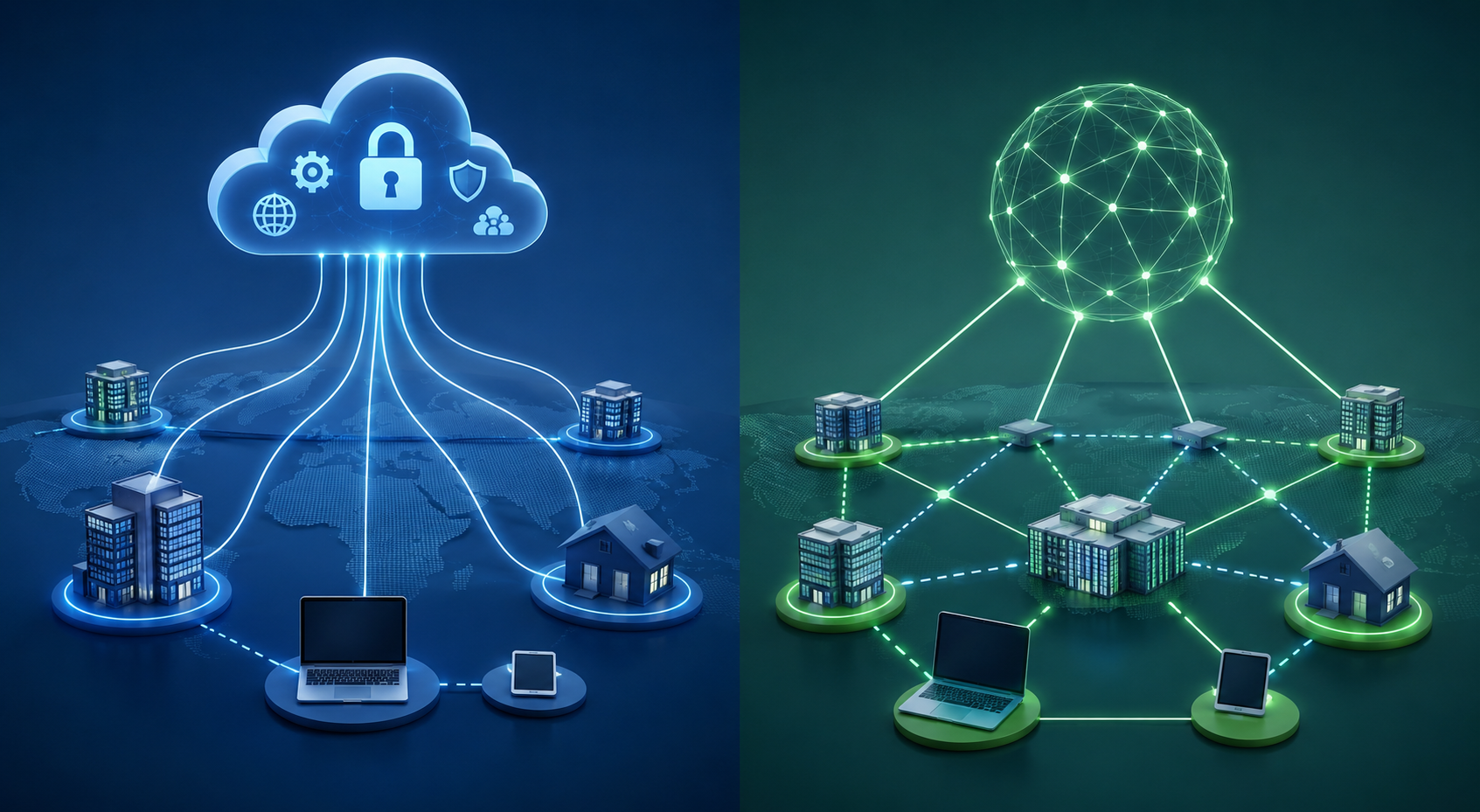
As businesses adopt more cloud applications, remote work and distributed networks, choosing the right approach to connectivity and security becomes increasingly important.
SD-WAN is designed to improve network performance and connectivity, while SASE combines networking and cloud-delivered security into a single architecture.
For many organisations, the question is not whether to choose SASE or SD-WAN. It is whether better connectivity alone is enough, or whether the business also needs secure access for remote users, cloud applications and Zero Trust environments.
In this article, we break down the key differences between SASE and SD-WAN, where each fits, and how to determine the right approach for your business.
What Is SD-WAN?
SD-WAN (Software-Defined Wide Area Network) is a networking technology that helps businesses manage traffic across multiple connections, such as broadband, MPLS, LTE and 5G.
Instead of sending all traffic through a fixed path, SD-WAN uses application-aware routing to direct traffic across the most suitable connection based on performance, availability and business policies.
This helps organisations improve application performance, support branch connectivity, simplify WAN management and reduce reliance on expensive private links.
Common SD-WAN benefits include:
-
Better branch-to-branch connectivity
-
Improved cloud application performance
-
WAN failover and resilience
-
Traffic optimisation
-
Centralised management and visibility
-
Reduced network costs
While Secure SD-WAN solutions can include security features, SD-WAN primarily focuses on connectivity and traffic management rather than broader access security.
What Is SASE?
SASE (Secure Access Service Edge) is an architecture that combines networking and security into a unified, cloud-delivered service.
It was developed to address the reality that users, devices and applications are no longer located within a single office network. Employees work remotely, businesses rely on SaaS applications, and data is spread across cloud environments.
A SASE framework typically combines:
-
SD-WAN
-
Zero Trust Network Access (ZTNA)
-
Secure Web Gateway (SWG)
-
Cloud Access Security Broker (CASB)
-
Firewall-as-a-Service (FWaaS)
-
Identity and policy-based access controls
Rather than focusing only on where traffic should go, SASE also evaluates who is accessing resources, which device they are using and whether access should be allowed. This makes SASE particularly valuable for organisations with remote workers, cloud applications, hybrid environments and Zero Trust initiatives.
SASE vs SD-WAN: Quick Comparison
|
Area |
SD-WAN |
SASE |
|
Main focus |
Network connectivity and traffic routing |
Secure access across users, devices, applications and cloud services |
|
Best for |
Branch networking and WAN optimisation |
Remote access, cloud security and Zero Trust |
|
Security |
Depends on deployment |
Core part of the architecture |
|
Delivery model |
Appliance, edge or hybrid |
Typically cloud-delivered or hybrid |
|
User coverage |
Primarily sites and branches |
Users, branches, devices and applications |
|
Relationship |
Can operate independently |
Often includes SD-WAN |
Need help choosing between SD-WAN, SASE or both? Explore FortiSecure’s SASE Without Regret solution or speak with our Fortinet specialists to plan a secure path from branch networking to cloud-delivered access security.
Key Differences Between SASE and SD-WAN
Connectivity vs Security
The biggest difference between SD-WAN and SASE is scope.
SD-WAN focuses on optimising network traffic. It determines the best path for applications and users while improving reliability and performance across multiple network links.
SASE includes those networking capabilities but extends them with cloud-delivered security and identity-based access controls.
In simple terms, SD-WAN focuses on how traffic moves, while SASE focuses on how traffic moves and who should be allowed access. This distinction becomes increasingly important as organisations adopt remote work, cloud applications and Zero Trust security models.
Branch Networking and WAN Performance
If your main challenge is connecting offices, retail stores, warehouses or branch locations, SD-WAN is often the logical starting point.
It helps businesses:
-
Improve application performance
-
Reduce WAN costs
-
Optimise internet usage
-
Improve failover and redundancy
-
Manage multiple locations centrally
For organisations primarily concerned with branch networking, Secure SD-WAN may provide everything they need.
Remote Users and Cloud Access
SASE becomes more valuable when users and applications are no longer confined to office locations.
Remote workers may connect from home, client sites, hotels, airports or mobile networks. At the same time, many business applications now reside in SaaS platforms and cloud environments rather than internal data centres.
In these situations, SASE provides:
-
Identity-based access controls
-
Consistent security policies
-
Secure access to cloud applications
-
Zero Trust access to private resources
-
Better visibility across users and devices
Rather than securing a network perimeter, SASE secures access wherever users connect.
When Does SD-WAN or SASE Make Sense?
The right choice depends on the problem your business is trying to solve.
SD-WAN is often the better fit when the priority is network performance and connectivity, particularly for organisations that:
-
Operate multiple office locations
-
Need WAN optimisation
-
Require internet failover
-
Want improved application performance
-
Need better visibility into network traffic
-
Want centralised branch management
For businesses primarily focused on connectivity, Secure SD-WAN may provide everything required without moving to a broader SASE architecture.
SASE becomes more relevant when secure access extends beyond the office network, particularly for organisations that:
-
Support remote or hybrid workers
-
Use SaaS and cloud applications extensively
-
Want to reduce VPN dependence
-
Need Zero Trust access controls
-
Require consistent security policies across locations
-
Need greater visibility into users and devices
As users, applications and data become more distributed, SASE helps apply security controls closer to the user and application rather than relying solely on traditional network boundaries.
Do You Need SASE, SD-WAN or Both?
In many cases, the answer is both.
SD-WAN and SASE are not competing technologies. In many deployments, SD-WAN forms part of a broader SASE strategy.
A common approach is:
-
SD-WAN for branch connectivity, traffic optimisation and failover
-
SASE for remote access, cloud security, Zero Trust and identity-based controls
This allows organisations to improve network performance while extending security beyond office locations.
As networking and security requirements evolve, organisations can build on their secure SD-WAN foundation by adding SASE capabilities for remote users, cloud applications and distributed environments.
Final Thoughts
SASE and SD-WAN solve related challenges, but they serve different purposes.
SD-WAN improves connectivity, application performance and branch networking. SASE builds on those capabilities by adding cloud-delivered security and identity-based access controls that protect users, devices and applications wherever they are located.
For organisations focused primarily on branch networking, Secure SD-WAN may be sufficient. For businesses supporting remote users, cloud applications and Zero Trust initiatives, SASE provides a broader framework for secure access.
The right choice depends on your environment, but for many organisations, the strongest long-term approach combines both: SD-WAN for connectivity and SASE for security.