
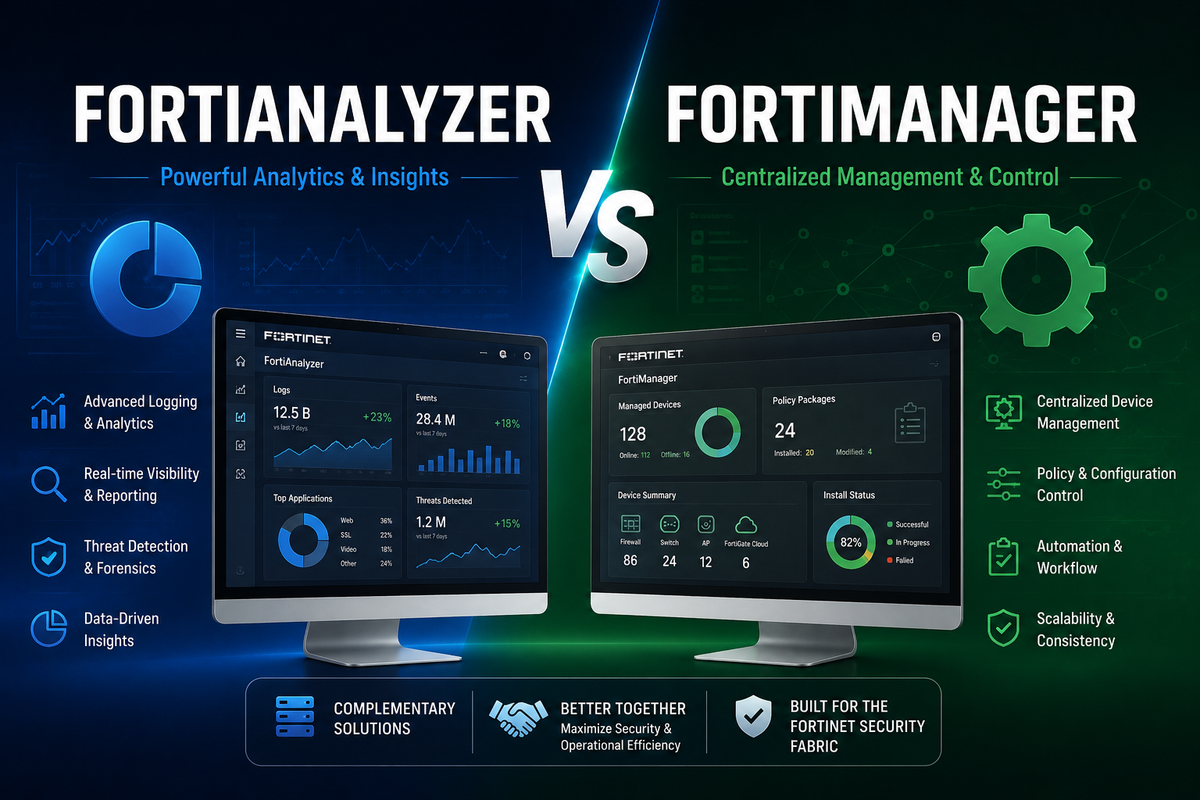
If you're building or expanding a Fortinet environment, you've likely come across both FortiAnalyzer and FortiManager. While they often appear together, they aren't interchangeable and understanding their roles is key to building an efficient and secure network.
FortiAnalyzer and FortiManager are both designed to support Fortinet environments, but they serve different purposes. FortiAnalyzer focuses on logging, analytics, reporting and security visibility, while FortiManager focuses on centralised device management, policy control, configuration and deployment.
Rather than replacing one another, the two products complement each other. FortiAnalyzer helps you understand what is happening across your network, while FortiManager helps you manage how your Fortinet devices are configured and secured. Below, we'll explore how they differ, when to use each one and why many organisations deploy both as part of their Fortinet strategy.
FortiAnalyzer vs FortiManager at a Glance
Before looking at each solution in more detail, here's a quick side-by-side comparison of FortiAnalyzer and FortiManager. This overview highlights their primary roles, common use cases and the key differences to help you identify which product best suits your needs.
|
Area |
FortiAnalyzer |
FortiManager |
|
Primary purpose |
Logging, analytics and reporting |
Centralised management and configuration |
|
Best for |
Security visibility and investigations |
Device and policy management |
|
Main question answered |
What happened? |
What should be configured? |
|
Typical users |
Security analysts and IT teams |
Network and system administrators |
|
Common tasks |
Log analysis, compliance reporting, threat investigation |
Firewall policy deployment, firmware management, SD-WAN administration |
|
Ideal environment |
Organisations needing reporting and visibility |
Organisations managing multiple Fortinet devices |
What Is FortiAnalyzer and When Should You Use It?
FortiAnalyzer is Fortinet's central logging and analytics platform. It collects logs from Fortinet devices, such as FortiGate firewalls, and transforms them into searchable data, dashboards, reports and security insights.
Instead of reviewing logs on individual devices, administrators can monitor activity across the network from a single interface. This makes it easier to investigate incidents, identify trends and generate reports for operational and compliance purposes.
FortiAnalyzer is commonly used for:
-
Centralised log collection
-
Security analytics
-
Threat detection and investigation
-
Compliance reporting
-
Historical log retention
-
User and application monitoring
-
Executive and technical reporting
-
Security Fabric visibility
For example, if your security team needs to investigate suspicious activity, determine which applications are consuming bandwidth or prepare compliance reports, FortiAnalyzer provides the information needed to answer those questions.
What Is FortiManager and When Should You Use It?
FortiManager is Fortinet's central management platform. It allows administrators to manage firewall policies, configurations, firmware, VPNs, SD-WAN settings and other administrative tasks across multiple Fortinet devices.
Managing a single firewall directly may be straightforward, but as networks expand, maintaining consistent configurations across many devices becomes increasingly difficult. FortiManager simplifies this process by allowing changes to be deployed from one location.
FortiManager is commonly used for:
-
Centralised FortiGate management
-
Firewall policy administration
-
Configuration management
-
Change control
-
Device provisioning
-
Firmware lifecycle management
-
SD-WAN administration
-
VPN management
-
Administrator workflows
-
Multi-site operations
For example, an organisation with multiple branch offices can deploy the same firewall policy across every location without configuring each device individually.
Should You Choose FortiAnalyzer, FortiManager or Both?
The right choice depends on the problem you're trying to solve.
Choose FortiAnalyzer if your organisation needs:
-
Better visibility into network activity
-
Centralised logging
-
Compliance reporting
-
Security investigations
-
Historical log analysis
-
User and application reporting
Choose FortiManager if your organisation needs:
-
Centralised device administration
-
Consistent firewall policies
-
Easier branch deployments
-
Configuration management
-
SD-WAN administration
-
Reduced manual configuration errors
Many organisations eventually deploy both products because they address different operational needs.
For instance, a network administrator might use FortiManager to deploy a new web filtering policy across every branch office. After deployment, FortiAnalyzer can monitor the policy's effectiveness by reporting on blocked websites, user activity, traffic patterns and security events.
Together, they provide both operational control and ongoing visibility.
Which Product Is Better for Common Use Cases?
Different operational needs call for different solutions. Here's how FortiAnalyzer and FortiManager compare across some of the most common use cases.
Security reporting
FortiAnalyzer is the better choice because it is designed to collect, store and analyse security logs while generating detailed reports.
Compliance
FortiAnalyzer plays the primary role by retaining logs and producing reports that help demonstrate security activity and compliance requirements.
Managing multiple FortiGate firewalls
FortiManager is the better option because it centralises policy management, configuration changes, firmware updates and device administration.
Multi-site environments
FortiManager simplifies administration across branch offices by allowing policies and configurations to be managed consistently from a central location.
Security investigations
FortiAnalyzer provides the detailed log data needed to investigate incidents, identify threats and analyse historical activity.
Why Many Businesses Deploy Both
FortiAnalyzer and FortiManager are designed to work together.
FortiManager manages your Fortinet infrastructure by deploying configurations and maintaining consistent policies across devices.
FortiAnalyzer monitors the results by collecting logs, analysing network activity, and providing reports that help administrators understand how those policies perform in production.
Using both products creates a continuous operational workflow:
-
Configure and deploy policies with FortiManager.
-
Monitor network activity with FortiAnalyzer.
-
Review reports and investigate security events.
-
Refine policies based on the insights collected.
For organisations with growing Fortinet environments, this combination provides stronger operational efficiency and improved security visibility than using either product alone.
Final Thoughts
FortiAnalyzer and FortiManager serve different but complementary purposes within the Fortinet ecosystem.
If your priority is understanding network activity, investigating security events and generating compliance reports, FortiAnalyzer is the right choice.
If your focus is managing multiple Fortinet devices, maintaining consistent firewall policies, and simplifying administration, FortiManager is the better fit.
As organisations grow, many deploy both solutions to combine centralised management with comprehensive reporting and analytics. Choosing the right starting point depends on whether your immediate priority is visibility, management, or both.
FAQs
What is the difference between FortiAnalyzer and FortiManager?
FortiAnalyzer focuses on logging, analytics, reporting and security visibility, while FortiManager focuses on managing Fortinet devices, firewall policies and configurations from a central location.
Is FortiAnalyzer the same as FortiManager?
No. They are separate products with different functions. FortiAnalyzer provides visibility into network activity, while FortiManager is designed for administration and policy management.
Do I need a FortiAnalyzer if I have a FortiManager?
You may still need FortiAnalyzer if you require centralised logging, reporting, compliance support, or security investigation. FortiManager is mainly for management, not deep reporting.
Do I need a FortiManager if I have a FortiAnalyzer?
You may need FortiManager if you manage multiple FortiGate firewalls or Fortinet devices and want centralised policy control, configuration management, and deployment workflows.
Can FortiAnalyzer and FortiManager work together?
Yes. Many organisations deploy both. FortiManager manages devices and configurations, while FortiAnalyzer collects logs, generates reports and helps monitor the effectiveness of those configurations.
Which is better for FortiGate reporting?
FortiAnalyzer is better for FortiGate reporting because it is designed for log analysis, reporting, and security visibility.
Which is better for managing multiple FortiGate firewalls?
FortiManager is better for managing multiple FortiGate firewalls because it centralises policy management, configuration, deployment, and operational control.