
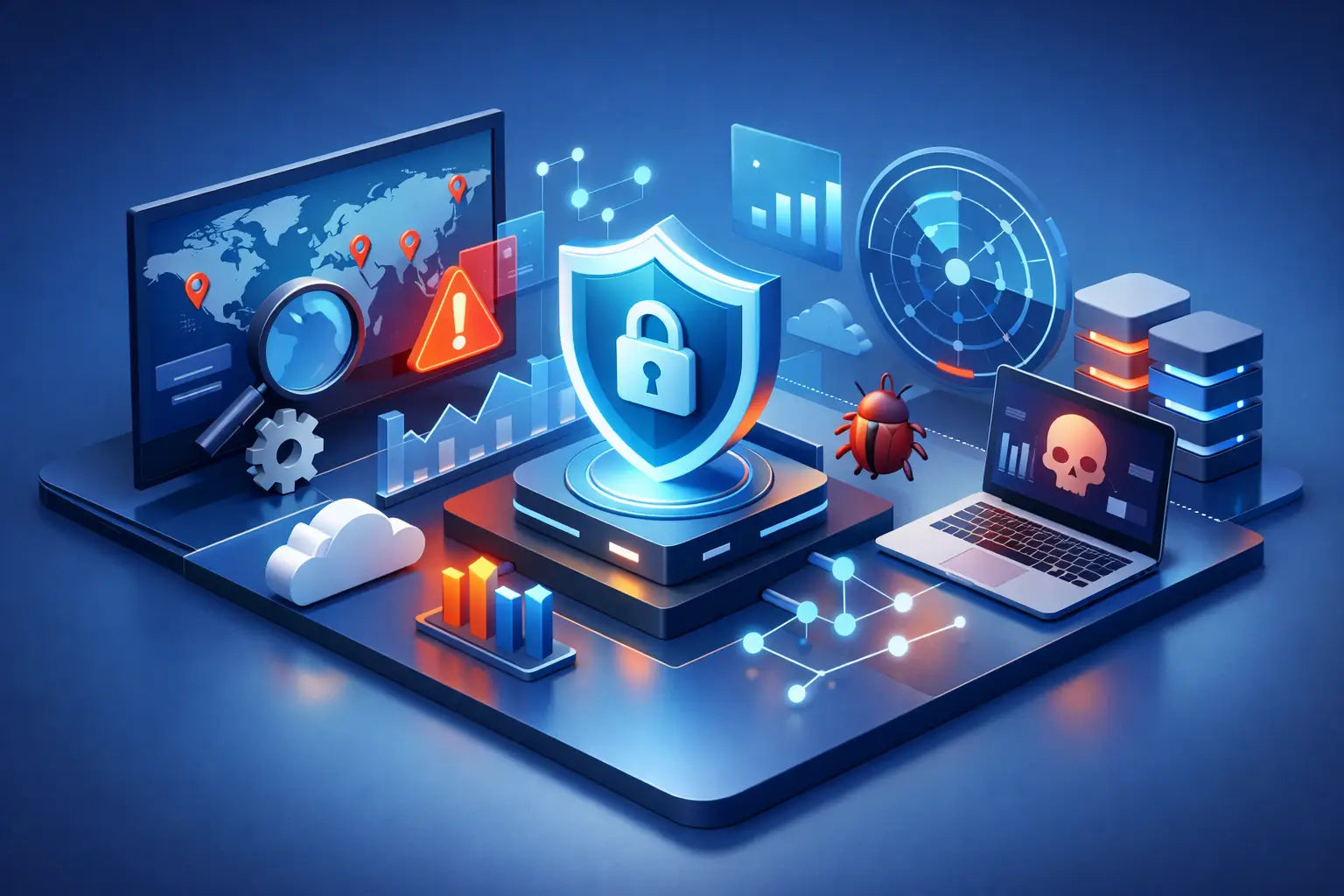
Security teams rarely struggle because they lack alerts. They struggle because they have too many of the wrong ones, arriving too late, in too many consoles, with too little context to act. That is where an advanced threat intelligence platform earns its place. Done properly, it turns scattered indicators, fragmented telemetry, and vendor noise into operational decisions your team can trust.
For Australian organisations, the challenge is not just volume. It is relevance. A mid-sized business with branch offices, cloud workloads, remote users, and compliance obligations does not need more generic threat feeds. It needs intelligence that helps prioritise real risk, reduce response time, and support a security architecture that can be run efficiently without hiring an army of analysts.
What an advanced threat intelligence platform actually does
An advanced threat intelligence platform is more than a feed aggregator. At a practical level, it collects intelligence from multiple sources, normalises it, enriches it, correlates it with your environment, and helps your security controls act on it. That sounds straightforward, but the difference between a useful platform and an expensive dashboard sits in the quality of that correlation.
If a platform simply lists indicators of compromise, your team still has to work out whether any of them matter to your network, endpoints, identities, cloud assets, or users. A stronger platform maps threat data against real exposure. It connects adversary behaviour, malware campaigns, infrastructure indicators, vulnerabilities, and industry targeting patterns to the systems you actually operate.
That context matters because not every threat deserves the same response. A phishing kit targeting Australian financial services deserves different attention from commodity botnet traffic that your controls already block. Good intelligence platforms help you make that distinction quickly.
Why businesses are moving beyond basic threat feeds
Traditional threat feeds often create work rather than remove it. They can be broad, duplicative, and difficult to validate. Security teams then spend time tuning, suppressing, cross-checking, and explaining why an alert did or did not matter. The operational cost becomes hard to justify.
An advanced threat intelligence platform should improve three areas at once. First, it should sharpen prioritisation by showing which threats are credible and relevant. Second, it should support faster containment through integration with firewalls, endpoint controls, SIEM, SOAR, email security, and cloud security tooling. Third, it should give decision-makers better visibility into threat trends, exposure, and control effectiveness.
For procurement and infrastructure leaders, that translates into a simpler commercial question. Are we paying for more data, or are we paying for better security outcomes? The right platform answers with measurable gains in efficiency and resilience.
The capabilities that matter most
Not every organisation needs the same depth of intelligence, but there are baseline capabilities worth insisting on. Source diversity is one. A platform that relies on a narrow set of intelligence inputs can miss emerging campaigns or overstate stale indicators. Enrichment is another. Raw indicators without asset, geography, malware, actor, or vulnerability context have limited operational value.
Integration should also be a serious buying criterion, not a nice-to-have. If intelligence cannot inform your existing controls, analysts end up copying and pasting between products. That increases delay and human error. In most environments, the platform needs to work cleanly with network security, endpoint protection, secure access, cloud visibility, and incident workflows.
The third major capability is confidence scoring. Security teams need a way to assess whether intelligence is current, corroborated, and worth actioning. A platform that cannot show why a threat is high-confidence will often produce hesitation at the worst possible time.
How an advanced threat intelligence platform supports Fortinet-led environments
In a unified security architecture, intelligence becomes more useful because the controls around it can act quickly. An advanced threat intelligence platform is especially effective when it feeds protections across firewalls, endpoint agents, secure email, sandboxing, identity controls, and centralised analytics. That reduces the gap between seeing a threat and stopping it.
This is where platform thinking matters. If your security stack is fragmented, threat intelligence may still be valuable, but the response path is slower and more manual. Analysts have to validate across separate systems, apply blocking logic in multiple places, and maintain more exceptions. By contrast, integrated environments give intelligence a clearer operational path.
For businesses already invested in Fortinet, or planning to standardise, the question is not simply whether threat intelligence exists. It is whether that intelligence is actionable across the broader security fabric. That is often the difference between a tool that looks capable in a demo and one that delivers day-to-day value in production.
Where buyers often get it wrong
A common mistake is buying for volume instead of relevance. More feeds do not automatically mean better protection. In many cases, they create duplication and force internal teams to sort signal from noise. Another mistake is treating threat intelligence as a standalone capability rather than part of a broader detection and response process.
There is also a tendency to overestimate internal capacity. Some organisations assume their team will tune workflows, map indicators, maintain playbooks, and continually adjust priorities after deployment. In reality, many IT and security teams are already stretched. If the platform needs constant manual care to stay useful, value erodes quickly.
Commercially, buyers can also underestimate operational fit. A lower upfront price may look attractive, but if the platform requires extra tooling, consulting, or analyst time to become effective, total cost rises fast. Best value is not the cheapest line item. It is the option that produces stronger protection with less friction.
Questions to ask before you buy
The strongest buying conversations usually start with your environment, not the vendor brochure. Consider what assets matter most, where your current blind spots sit, and which workflows consume the most analyst time. If phishing, cloud exposure, branch connectivity, and endpoint visibility are your pressure points, the platform should improve those areas clearly.
It is also worth asking how intelligence is validated, how often it is refreshed, and how false positives are managed. If a vendor cannot explain its scoring and enrichment model in plain language, that is a warning sign. Security leaders need transparency, especially where automated response is involved.
Finally, assess whether the platform supports your compliance and reporting obligations. In regulated environments, threat intelligence is not just an operational tool. It can help demonstrate risk awareness, control maturity, and incident readiness. That becomes more valuable when reporting needs to be credible across technical and executive audiences.
It depends on your operating model
A large enterprise with a mature SOC may want deep customisation, broad ingestion, and advanced automation. A mid-market business may care more about curated intelligence, fast deployment, and straightforward integration with existing controls. Neither approach is wrong. The right fit depends on internal capability, risk profile, and how centralised your security operations are.
This is why solution design matters. A platform can be technically impressive and still be a poor fit if it assumes resourcing you do not have. For many Australian organisations, especially those balancing security uplift with commercial discipline, the ideal approach is a platform that supports enterprise-grade intelligence without creating an enterprise-grade management burden.
That is also where authorised specialists add value. Product selection should be tied to architecture, deployment realities, and support options, not just feature checklists. FortiSecure Store approaches this from a practitioner lens because good security buying decisions have to survive beyond procurement and into operations.
What success looks like after deployment
A well-chosen platform should make your team more decisive. Analysts should spend less time validating basic alerts and more time handling material risks. Blocking actions should become faster and more consistent. Reporting should improve because threat data is connected to business exposure rather than presented as isolated technical noise.
You should also see cleaner prioritisation across vulnerability management, incident response, and control tuning. When intelligence is current and relevant, patching decisions become more defensible, detections improve, and executive conversations become clearer. Security leaders can explain not just what happened, but why it mattered and what was done about it.
That is the standard worth holding. An advanced threat intelligence platform should not be purchased because the market says you need one. It should be adopted because it helps your organisation make better security decisions, faster, with less operational drag and stronger commercial sense.
If your current stack produces more noise than clarity, the next step is not another feed. It is a platform and architecture that turn intelligence into action your business can afford to maintain.