
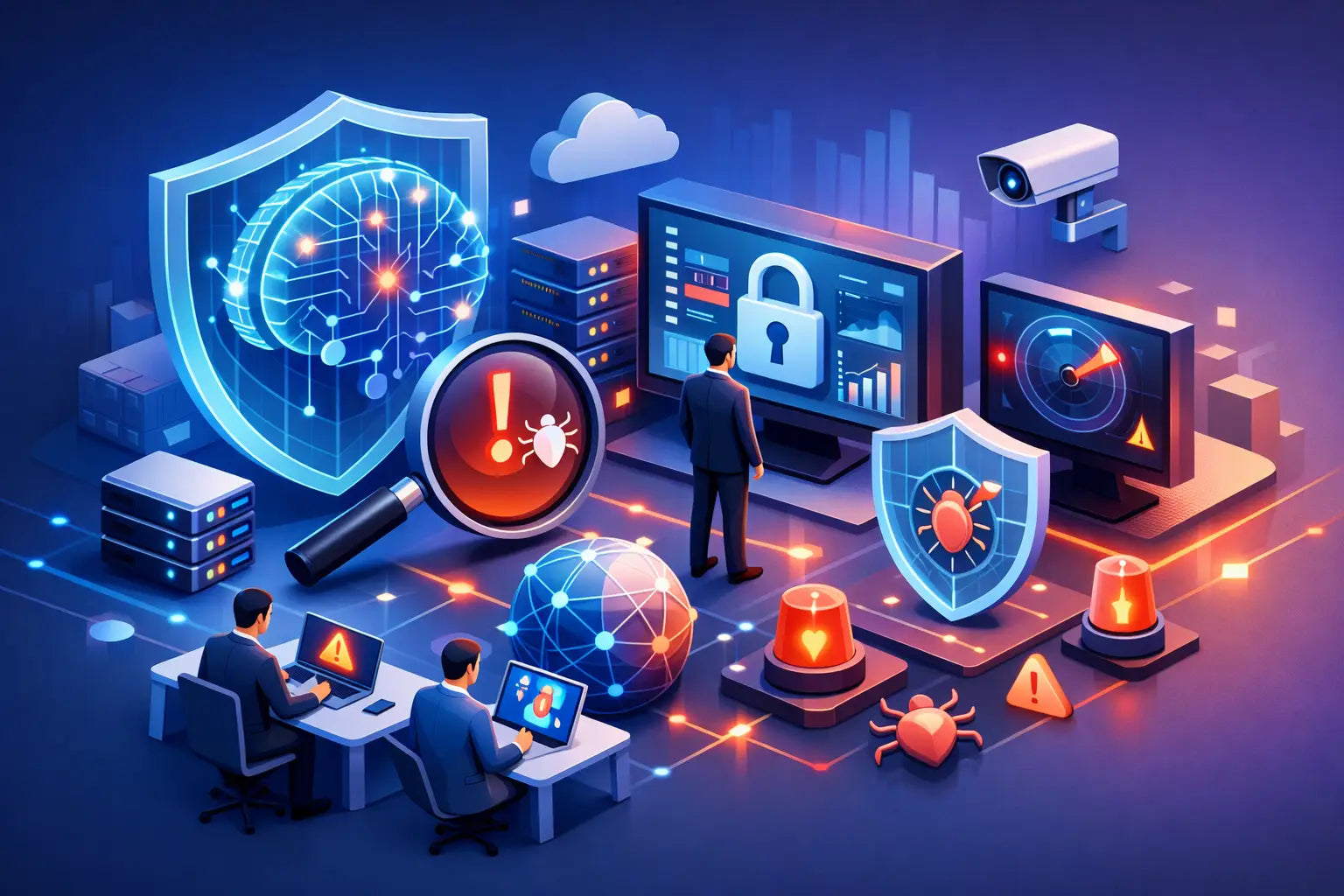
A ransomware alert at 2:13 pm rarely arrives with perfect context. What the security team sees first is usually noise - a suspicious login, unusual traffic between devices, a burst of file activity, or an endpoint behaving out of pattern. That is where ai threat detection for business matters. It helps teams identify what deserves immediate attention, what can wait, and what is likely a false alarm before operational impact spreads.
For most organisations, the issue is not a lack of security tools. It is a lack of clarity across them. Firewalls, endpoint controls, email protection, identity systems and cloud platforms all generate telemetry, but few internal teams have the time to manually stitch those signals together. AI changes that equation when it is applied properly. Not as a marketing feature bolted onto another dashboard, but as part of a coordinated detection and response approach that reduces analyst load and improves decision speed.
What ai threat detection for business actually does
At a practical level, AI-driven threat detection analyses large volumes of activity data to find patterns that suggest malicious behaviour, policy abuse, lateral movement, compromised credentials or emerging attack techniques. It can process more events, more quickly, than a human team working across disconnected consoles.
That speed is useful, but speed alone is not the outcome buyers should care about. The real value comes from correlation and prioritisation. If an employee logs in from a new location, downloads an unusual amount of data, and then initiates connections to systems they do not normally access, AI can connect those events into a higher-confidence signal. Without that correlation, each event may appear low risk in isolation.
This matters for SMBs and mid-market organisations especially. Many have lean IT teams, limited security headcount and compliance obligations that do not shrink just because the internal team is small. AI can help close that operational gap, provided it is supported by sensible policies, clean architecture and experienced deployment.
Why traditional detection models are struggling
Older detection approaches still have value. Signature-based controls, rule-based alerts and manually tuned thresholds remain part of a sound security stack. The problem is that attackers do not rely on one predictable technique. They blend legitimate tools with malicious intent, move across hybrid environments and exploit small gaps between network, identity and endpoint visibility.
That creates three common challenges. First, alert volumes become unmanageable. Second, genuine threats are buried inside normal business activity. Third, security teams spend too much time validating alerts and not enough time containing incidents.
AI helps by learning baseline behaviour and spotting deviations that static rules may miss. It can surface unusual east-west traffic, impossible travel events, suspicious privilege escalation or command activity associated with known attacker behaviour. But there is a trade-off here. If the model is poorly tuned or fed incomplete telemetry, it can generate more confusion rather than less. Good outcomes depend on visibility, integration and policy discipline.
Where AI threat detection delivers the most value
The strongest use case for ai threat detection for business is not one device or one control point. It is visibility across the attack path.
On the network side, AI can identify command-and-control traffic, internal reconnaissance, abnormal application use and segmentation breaches. On endpoints, it can detect unusual process execution, persistence techniques and suspicious file behaviour. In cloud and SaaS environments, it can highlight access anomalies, misused credentials and patterns that suggest account compromise.
Email and identity are just as important. Many successful incidents start with phishing, token theft or weak access hygiene rather than an obvious firewall event. AI becomes more valuable when those identity, endpoint and network signals are analysed together. A login anomaly alone may not justify action. Combined with mailbox changes, endpoint script execution and outbound traffic spikes, it becomes a credible incident trail.
For regulated sectors, the value also extends to reporting and defencibility. Detection quality affects incident response, but it also affects how confidently an organisation can demonstrate monitoring capability, control maturity and response readiness during audits or post-incident reviews.
What good implementation looks like
Buying an AI-labelled security product is not the same as deploying an effective detection capability. In practice, good implementation starts with architecture.
The first question is whether your tools share context. If network, endpoint, identity and cloud controls operate in isolation, AI has less useful data to work with. Unified platforms generally produce better detection outcomes because they reduce telemetry gaps and support stronger correlation.
The second question is whether policies reflect how the business actually operates. A manufacturing site, professional services firm and multi-branch retailer all generate different patterns of normal activity. Detection logic should account for that. Otherwise, teams end up chasing expected behaviour flagged as suspicious.
The third question is response. Detection without a clear containment path is only half a control. If AI identifies a likely compromised endpoint, can the device be isolated quickly? If unusual access is detected, can credentials be revoked or sessions terminated without delay? The closer detection is tied to response actions, the more value the business sees.
This is where platform alignment matters. Fortinet environments, when designed properly, can combine network security, endpoint telemetry, secure access and centralised visibility in a way that makes AI-driven detection more operationally useful, not just more technically impressive.
The trade-offs buyers should assess
AI threat detection is not a magic fix for poor security hygiene. It will not compensate for unpatched systems, weak access controls, flat networks or inconsistent policy enforcement. It also does not remove the need for skilled oversight. Teams still need to validate incidents, tune controls and understand business context.
There is also a cost conversation, and smart buyers should have it early. More advanced detection can reduce risk exposure and manual effort, but it needs to be measured against licensing, deployment complexity, integration effort and ongoing support requirements. The lowest upfront price does not always produce the best long-term result. Equally, the most feature-rich platform is not automatically the right fit for every environment.
For some businesses, the best outcome is a tightly integrated core stack with a manageable set of detection and response controls. For others, particularly those with multiple sites, compliance obligations or limited internal expertise, the better option may include specialist support for configuration, tuning and managed oversight. It depends on internal capability, risk profile and how quickly the organisation needs to improve maturity.
How to evaluate AI threat detection for business
A sensible evaluation should focus less on vendor claims and more on operational questions. Ask how the platform improves visibility across network, endpoint, cloud and identity. Ask what telemetry is native versus dependent on third-party connectors. Ask how incidents are prioritised, how false positives are reduced, and what response actions can be triggered from the same environment.
It is also worth asking who will run it. If your internal team is already stretched, a technically capable platform may still underperform without proper onboarding and ongoing tuning. Certified deployment support, practical design guidance and local expertise often make the difference between shelfware and measurable protection.
For Australian organisations, local requirements matter as well. Data handling expectations, sector-specific obligations and business continuity risks all influence what good detection looks like. A branch office network, healthcare provider and education environment will not have the same operational tolerances. Detection strategy should reflect that reality rather than rely on a generic settings profile.
The commercial case is stronger than many expect
Security buyers are rightly sceptical of hype, particularly around AI. The useful question is not whether AI sounds advanced. It is whether it lowers operational friction while improving detection accuracy and response speed.
When implemented properly, the answer is often yes. Teams waste less time sorting low-value alerts. Threats are identified earlier in the attack chain. Security investments work harder because controls share context instead of generating isolated warnings. That can translate into less downtime, faster investigations and a better return on the tools already in place.
It also supports procurement discipline. A unified, AI-assisted approach can reduce the need to stack disconnected point products that each add cost, management overhead and visibility gaps. For businesses trying to balance stronger security with budget control, that matters.
AI threat detection is most effective when treated as part of a broader security architecture, not a shortcut around one. Get the design right, align controls across the environment, and make sure detection feeds directly into action. That is how businesses move from more alerts to better outcomes - and from security spend that looks busy to security that is actually doing its job.