
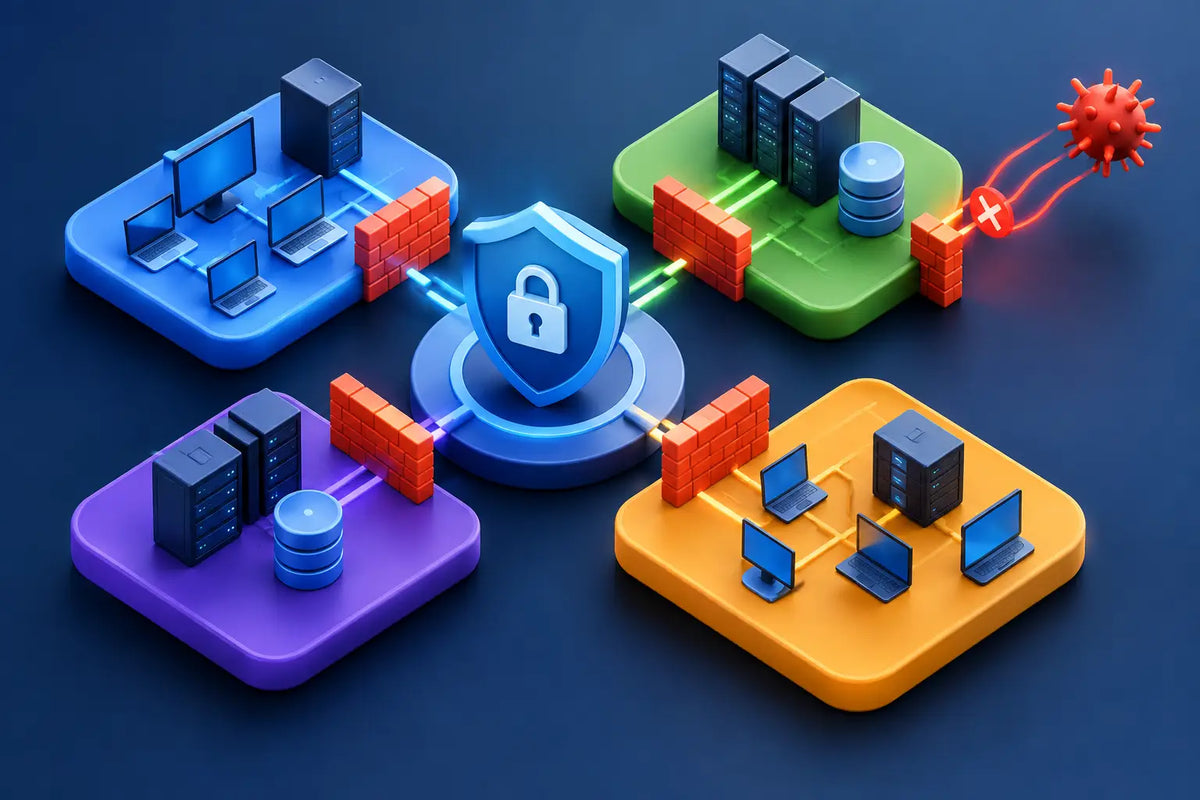
A compromised user account should not provide a free path to your finance platform, production systems, backup repositories and every branch office. That is the operational case for network segmentation: limiting what people, devices and workloads can reach, so one failure does not become a business-wide incident.
For Australian organisations managing hybrid work, cloud services, operational technology and multiple sites, a flat network is increasingly difficult to defend. Segmentation provides the control points needed to reduce lateral movement, apply policy consistently and investigate suspicious activity with more confidence. Done well, it also supports better uptime and clearer compliance evidence.
What network segmentation actually does
Network segmentation divides an environment into separate security zones and controls the traffic permitted between them. The goal is not simply to create more VLANs. It is to define trust boundaries around systems with different roles, risk profiles and business value, then enforce only the connections those systems genuinely require.
A practical design might separate corporate users from guest wireless, server workloads from user devices, point-of-sale systems from office networks, and management interfaces from ordinary administration traffic. Critical services such as identity infrastructure, finance applications, backups and security tools should receive particular attention because compromise of these systems can rapidly increase an attacker’s reach.
The principle is straightforward: deny unnecessary paths by default, then allow documented, justified traffic. A payroll application may need to communicate with a database service on a specific port. It does not need unrestricted access to every workstation, printer or cloud-connected appliance in the business.
Segmentation is often discussed as a cyber security control, but its operational value matters just as much. When a device is infected or misconfigured, well-defined zones can contain the disruption. IT teams can isolate an affected area without taking down every service, which is a materially better outcome than disconnecting the whole site under pressure.
Why flat networks create expensive exposure
In a flat network, internal traffic is treated as inherently trustworthy. Once an attacker gains a foothold through phishing, an exposed remote service, a vulnerable device or stolen credentials, they can scan for systems, reuse credentials and move towards higher-value assets.
This is how a minor endpoint event becomes a ransomware incident. The initial compromise may be a single laptop, but unrestricted access can expose file shares, domain services, virtualisation platforms and backup infrastructure. Recovery costs then extend beyond remediation to downtime, customer disruption, forensic investigation and potential reporting obligations.
Flat designs also make policy difficult to manage. If every device sits in one broad address range, there is little context for a firewall or security team to distinguish expected traffic from risky traffic. Logs become noisy, exceptions multiply and troubleshooting becomes slower.
Segmentation introduces useful context. A connection from a guest device to an internal finance server is clearly abnormal. A building-management controller attempting to reach a domain controller warrants investigation. Security controls become more precise because they can assess source zone, destination zone, user identity, device posture and application behaviour together.
Build the design around business functions
The most effective segmentation projects begin with business services, not product features. Start by identifying the systems that must remain available, the data that requires stronger protection, and the dependencies that keep critical workflows operating.
For a small business, this may mean isolating guest Wi-Fi, staff devices, servers, VoIP handsets and management access. A multi-site organisation may also need distinct policies for branches, warehouses, cloud workloads and third-party support connections. Enterprises may extend the model to development environments, payment systems, operational technology and separate business units.
The right number of zones depends on the organisation. Too few zones leave meaningful exposure; too many can create policy sprawl and operational friction. The best design is detailed enough to enforce clear security boundaries, but simple enough for internal teams or managed providers to maintain confidently.
Identify critical assets and traffic flows
Before changing rules, map the systems that matter and how they communicate. Include obvious services such as servers and cloud applications, but do not overlook network switches, wireless controllers, hypervisors, backup appliances, printers, cameras and Internet of Things devices.
This exercise often reveals undocumented dependencies. An older application may rely on a database port that nobody has recorded. A vendor may require remote access to a specialised system. Blocking these flows without validation can interrupt operations, so discovery and staged testing are essential.
Define zones by trust and purpose
A useful approach is to group assets with similar security requirements. Common zones include user devices, servers, guest access, voice, corporate wireless, network management, security management, third-party access and operational technology.
Management networks deserve strong separation. Administrative interfaces for firewalls, switches, servers and hypervisors should not be broadly reachable from everyday user devices. Restrict access to authorised administrators, apply multi-factor authentication where available, and log administrative activity. This reduces the chance that a compromised endpoint can be used to take control of core infrastructure.
Apply least-privilege policies between zones
Each connection between zones should have an owner and a purpose. Permit the required application traffic, from the required source, to the required destination. Avoid broad rules such as “any internal to any internal” simply because they are convenient during deployment.
Policy design must remain practical. Some services, especially legacy applications, may need temporary wider access while dependencies are understood. Record these exceptions, assign a review date and reduce them over time. A documented exception is manageable; an invisible one becomes permanent risk.
Use segmentation controls that fit the environment
VLANs provide logical separation at the network layer, but they are not the whole solution. Without controlled routing and security inspection between VLANs, they can become little more than organisational labels. A next-generation firewall placed at key boundaries can enforce policies, inspect applications, apply intrusion prevention and provide visibility into traffic crossing zones.
For many organisations, a Fortinet architecture can combine firewall-based segmentation, secure switching, wireless access control and centralised management. This helps avoid a fragmented collection of point products, while allowing policy to be applied across head office, branches and remote connectivity. The commercial benefit is not merely buying fewer tools. It is reducing the time and specialist effort required to operate the controls properly.
Identity-aware controls add another layer of precision. Rather than treating every device in a subnet alike, policies can account for a user’s role, the device type and its security posture. This is especially useful for hybrid work and bring-your-own-device scenarios, where network location alone is no longer a reliable indicator of trust.
Microsegmentation can take this further by controlling traffic between individual workloads or applications. It is valuable for highly sensitive server environments and cloud workloads, but it requires good visibility and careful policy management. For many small and mid-market organisations, strong zone-based segmentation delivers the greatest risk reduction first. Microsegmentation can then be introduced where the risk and operational maturity justify it.
Avoid the common deployment mistakes
The first mistake is treating segmentation as a one-off network project. Business systems change, sites move, applications are replaced and new cloud services appear. Policies require regular review or they gradually stop reflecting reality.
The second is blocking traffic before understanding the environment. A strict default-deny position is the right destination, but reaching it safely may require monitoring mode, traffic baselining and phased enforcement. Begin with a high-value boundary such as guest access, management systems or backup infrastructure, validate the outcomes, then expand.
The third is overlooking encrypted and remote traffic. Branch-to-head-office connections, cloud applications and remote users must be part of the policy model. If security rules apply only inside the main office, the organisation has created a gap precisely where visibility is often weakest.
Finally, do not confuse complexity with security. Hundreds of poorly named rules, duplicated objects and undocumented exceptions make incident response harder. Clear naming standards, policy owners, change control and regular reporting are core parts of a sustainable design.
A practical path to stronger segmentation
A sensible implementation usually progresses through four stages:
- Assess critical services, data flows, current firewall rules and unmanaged devices.
- Establish high-value zones for guest access, management, servers, backups and third parties.
- Enforce least-privilege policies in phases, monitoring for unexpected dependencies.
- Review rules, logs and exceptions regularly as systems and business requirements change.
FortiSecure Store can assist organisations that need certified guidance on selecting and deploying Fortinet firewalls, switches, wireless and supporting security services as part of a commercially sound segmentation plan.
The most valuable next step is not buying more technology blindly. It is identifying one pathway that should never be unrestricted - such as user devices to backups or guest Wi-Fi to internal systems - and closing it with a policy your team can explain, monitor and maintain.