
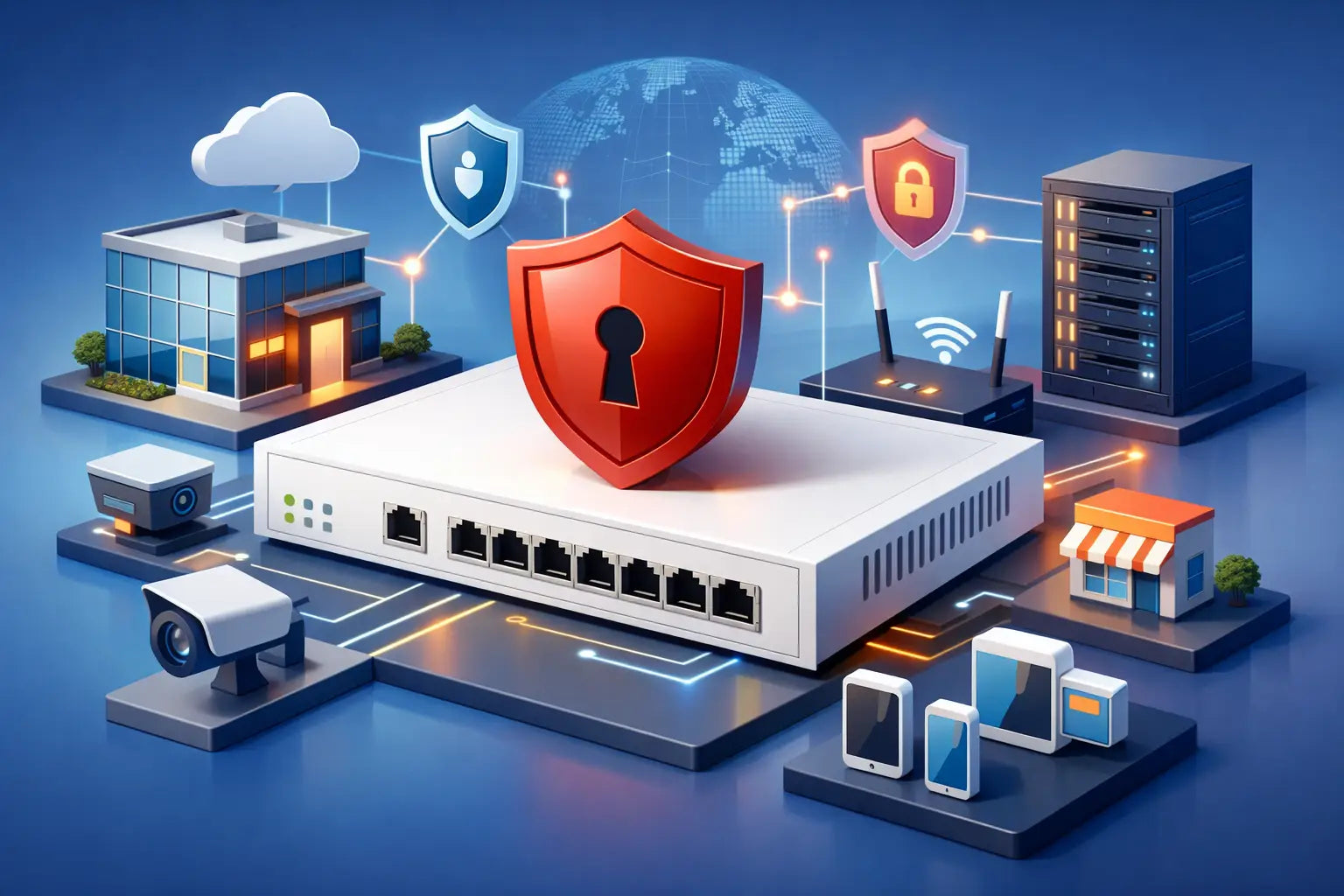
A small business usually notices its firewall only when something goes wrong - slow internet, a VPN that drops out, staff clicking the wrong link, or a compliance question that suddenly lands on the IT manager’s desk. That is exactly where a FortiGate firewalls for small business earns its place. It is not just there to block traffic. It sits at the centre of how you control risk, keep operations moving, and avoid building a security stack that costs more to run than it protects.
For smaller organisations, the real challenge is rarely whether to buy a firewall. It is choosing one that gives you enough protection without overcomplicating procurement, deployment and day-to-day management. FortiGate has become a strong fit in this space because it brings enterprise-grade security capabilities into models and licensing options that can be scaled for smaller environments.
Why a FortiGate firewall for small business makes commercial sense
Small businesses are often expected to defend against the same threats as larger organisations, but with fewer people, tighter budgets and less time to maintain separate tools. That is where point solutions can become expensive. One product handles web filtering, another manages VPN, another covers intrusion prevention, and soon the business is paying for overlap while still carrying gaps.
A FortiGate appliance takes a different approach. It combines firewalling, SD-WAN, secure remote access, application control, web filtering and threat protection in one platform. For a small business, that matters because fewer moving parts usually means faster deployment, clearer policy management and less operational friction.
There is also a practical finance angle. The lowest sticker price is not always the best value. A cheaper firewall that struggles under inspection load, lacks support options, or needs extra products to do basic security work often becomes more expensive over its usable life. FortiGate is typically considered when buyers want to reduce that kind of hidden cost while still maintaining professionally aligned protection.
What small businesses actually need from a firewall
Not every small business has the same risk profile. A ten-person professional services firm has different priorities from a retail chain, medical clinic or manufacturer with remote sites. Still, a few needs show up again and again.
The first is visibility. If you cannot see what applications are being used, where traffic is going, or which devices are connecting, you are managing by assumption. The second is control. Small businesses need to set sensible rules around web access, remote work, guest networks and cloud applications without spending days writing policies. The third is performance. Security inspection is only useful if it does not turn the network into a bottleneck.
FortiGate addresses these needs well because it is designed as a unified security platform, not just a basic traffic filter. That means your policies can be more granular, your reporting more useful, and your deployment path more consistent as the business grows.
Choosing the right FortiGate model
This is where many buyers either overspend or underspec the environment. A firewall should be sized for real-world use, not only for the current internet plan or user count on paper.
Start with the basics. How many users are in the office on a normal day? How many work remotely? Are you inspecting encrypted traffic? Are you running cloud applications heavily? Do you need site-to-site VPNs for branches, warehouses or home offices? Once those questions are answered, model selection becomes more disciplined.
For a smaller office with modest user numbers, entry-level desktop FortiGate units can provide strong security and enough throughput for internet access, VPN and standard threat inspection. If the business expects growth, more cloud usage or multiple WAN links, moving up a model range early can be the better decision. Buying too close to the edge usually leads to refresh pressure sooner than expected.
It also depends on resilience requirements. Some small businesses can tolerate short interruptions during maintenance or hardware replacement. Others cannot. A legal practice, healthcare provider or business with a busy online ordering system may need high availability considerations even at a smaller scale.
Licensing and subscriptions matter more than the box
A firewall appliance without the right services is only part of the solution. For most small businesses, the real value comes from the security subscriptions that enable advanced protection and ongoing threat intelligence.
That includes capabilities such as intrusion prevention, antivirus, web filtering, application control and security updates. If your requirement includes email exposure, remote access controls or broader platform integration, the design may extend beyond the firewall itself. This is why curated bundles tend to make more sense than trying to decode part numbers in isolation.
The trade-off is straightforward. A lower upfront purchase can look attractive, but if it strips out essential protection or leaves the environment under-licensed, the business takes on unnecessary risk. On the other hand, not every small business needs the broadest bundle from day one. The right licensing position should reflect actual risk, compliance obligations and operational plans.
Deployment is where good purchasing decisions show their value
A well-chosen FortiGate still needs to be deployed properly. This is often underestimated by organisations that assume installation ends once the device is online.
In practice, a useful deployment includes network segmentation, sensible security policies, VPN configuration, traffic shaping where needed, and logging that supports troubleshooting and audit needs. If the business has guest Wi-Fi, voice services, cloud applications or multiple sites, those settings need to work together rather than being patched in later.
This is also where buying from practitioners makes a difference. Small business buyers do not usually need a generic carton drop. They need a solution that matches the business model, connectivity design and support expectations. FortiSecure Store is built around that reality, combining authorised Fortinet supply with certified Australian guidance for organisations that want security done right and cost done better.
Where FortiGate fits best for Australian small businesses
For Australian organisations, local context matters. NBN variability, regional connectivity, distributed workforces, and increasing expectations around data security all influence firewall design.
A FortiGate can be especially effective for small businesses that need secure branch connectivity, reliable VPN for hybrid work, and stronger control over web and application use. It is also well suited to organisations that want to simplify fragmented security environments and move towards a more unified platform.
There is a compliance dimension as well. Even when a business is not operating in a heavily regulated sector, customers and partners increasingly expect evidence of reasonable security controls. A professionally deployed next-generation firewall helps support that position. It will not solve compliance on its own, but it can form a credible foundation for access control, monitoring and policy enforcement.
Common mistakes to avoid
The most common mistake is buying on throughput numbers alone. Vendor datasheets matter, but they do not always reflect your exact traffic mix, security features in use or growth plans. A firewall that looks fine in theory can feel undersized once SSL inspection, VPN users and cloud traffic are added.
Another mistake is treating licensing as optional until later. In most cases, delaying the relevant subscriptions means delaying the protection the business actually needs.
The third is underestimating support. Small businesses often do not have dedicated security engineers available every day. When configuration, renewals, policy tuning or troubleshooting are needed, access to certified support can save both time and risk.
Is FortiGate the right choice for every small business?
Not automatically. If a business has extremely simple connectivity, no remote access, very limited compliance pressure and no expectation of growth, there may be lower-cost options that meet a minimal requirement. But that is not the same as being the best long-term decision.
FortiGate is usually strongest where the business wants room to grow, enterprise-grade controls, and a cleaner path to managing security in one place. It is particularly compelling when buyers want to avoid the false economy of stacking separate products just to recreate capabilities that are already integrated within the platform.
The best buying decision is the one that matches commercial reality with operational risk. That means looking beyond the appliance itself and asking a better question: what level of protection, performance and support does the business need over the next three years, not just this quarter?
A firewall should do more than sit quietly in the comms rack. For a small business, it should reduce complexity, support resilience and give decision-makers confidence that growth is not coming at the expense of security.