
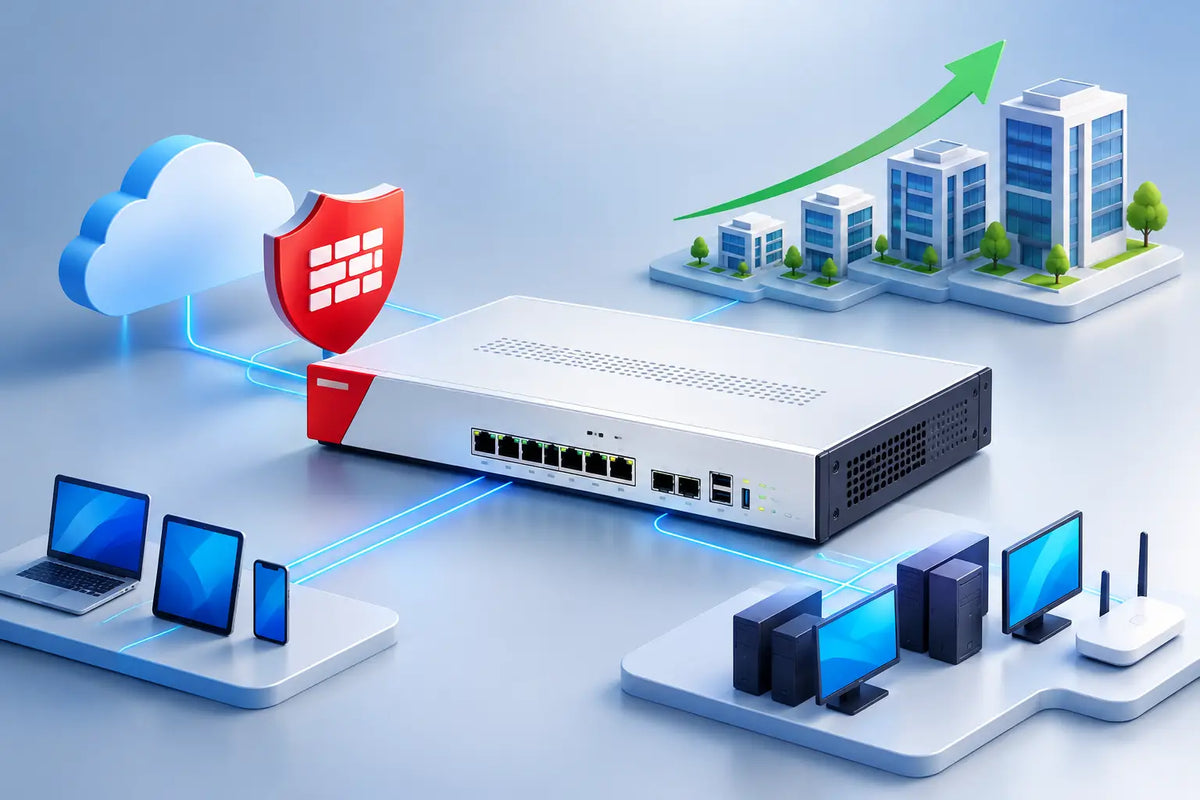
A firewall refresh becomes urgent when the existing appliance is not merely ageing, but actively constraining the business. VPN performance drops under load, security inspection is switched off to preserve speed, branch connectivity becomes difficult to manage, and every new service creates another exception. This FortiGate 120G review considers whether Fortinet’s mid-range appliance is the right response for Australian organisations that need stronger protection without buying enterprise capacity they will not use.
The FortiGate 120G is best understood as a consolidation platform for growing sites, regional offices and security-conscious mid-market networks. It combines high-speed firewalling, application control, intrusion prevention, secure SD-WAN, VPN, segmentation and access to FortiGuard security services in one operating system. That matters where IT teams want fewer disconnected products, clearer policy control and a practical path to stronger resilience.
FortiGate 120G review: where it fits
The 120G sits in the space between smaller branch firewalls and larger appliances designed for high-density campuses or data centre edge deployments. It is a sensible candidate when a site has a meaningful number of users, several internet services, cloud applications, remote access needs and a requirement to inspect traffic rather than simply pass it through.
Its value is not just raw throughput. A firewall should be assessed on the security functions that will actually be enabled: IPS, application control, web filtering, malware protection, SSL/TLS inspection, VPN and logging. Organisations that size a firewall only on basic firewall figures often find that performance headroom disappears once their intended security policy is applied. The 120G is designed for organisations that need to run these services with operational confidence, rather than treating them as optional extras.
For a distributed organisation, secure SD-WAN is another material advantage. The appliance can apply business intent to traffic paths, favouring the best available connection for critical services while maintaining policy enforcement at the branch. This is particularly useful for businesses using a combination of NBN, fibre, Ethernet, 4G or 5G services. The aim is not to make every link identical. It is to use each link intelligently while keeping security policy consistent.
Performance is only useful when security is switched on
The strongest case for the FortiGate 120G is its ability to bring network performance and security inspection into the same design. Fortinet’s purpose-built security processing architecture is intended to reduce the trade-off between protection and speed, especially for common functions such as firewall inspection, IPS and encrypted traffic handling.
That does not mean every feature can be enabled without planning. Deep SSL inspection, extensive logging, demanding VPN usage and layered security profiles all consume resources. They also require careful policy design to avoid breaking legitimate applications or creating a support burden for the service desk. A sound deployment starts with identifying the traffic that genuinely needs full inspection, the applications that need priority and the systems that warrant separate network segments.
For many organisations, the better question is not, “Can the 120G handle our internet connection?” It is, “Can it handle our internet connection, remote users, cloud traffic and security policy at the same time, with room for growth?” That is where a properly sized FortiGate delivers measurable value.
Ports and connectivity need a real-world check
The 120G provides connectivity suited to modern business networks, including higher-speed interfaces for uplinks and demanding local connections. This makes it relevant where organisations are moving beyond basic gigabit access, adding faster internet services or connecting higher-capacity switching infrastructure.
However, port counts alone should not decide the purchase. Confirm whether the design needs copper or fibre hand-offs, separate WAN links, dedicated management, HA connectivity, DMZ interfaces, switch uplinks or additional segmentation zones. Also confirm whether power over Ethernet is required at the firewall layer. If wireless access points, phones or cameras need PoE, that requirement is generally better addressed through appropriately specified switching rather than assumed as part of the firewall purchase.
A practical bill of materials should cover the firewall, FortiGuard subscriptions, support entitlement, compatible switches and access points where needed, optics or DAC cables, and the implementation effort. This prevents a competitively priced appliance from becoming an under-scoped project.
Security architecture, not feature accumulation
FortiOS is central to the 120G proposition. The same policy framework can govern firewall rules, VPNs, SD-WAN, segmentation, web access and security inspection. For IT teams managing multiple sites, that consistency is often more valuable than a long list of standalone features.
The appliance also fits naturally into a broader Fortinet Security Fabric design. It can share context with FortiSwitch, FortiAP, FortiClient, FortiAnalyzer and FortiManager, depending on the organisation’s requirements. This can reduce blind spots between network, endpoint and wireless environments, while giving administrators more useful visibility during an incident.
There is a commercial benefit as well. Consolidating functions can reduce licensing overlap, appliance sprawl and the time spent reconciling alerts across unrelated consoles. That said, consolidation should not be confused with automatic simplicity. A unified platform still needs a clear security standard, named ownership and ongoing review of rules, subscriptions and software versions.
Secure remote access and branch operations
For organisations with hybrid staff, contractors or multiple locations, the FortiGate 120G can support encrypted connectivity without making remote access a separate security silo. Site-to-site VPN, remote user VPN and identity-aware access policies can be designed within the same security environment.
The quality of that experience depends on the identity design behind it. Multi-factor authentication, least-privilege access, device posture and clear group-based policy should be considered from the outset. Giving all remote users broad network access because the VPN is encrypted is not a security strategy.
Branch deployments also benefit from standardisation. A repeatable template for WAN configuration, VLANs, security profiles, logging and remote access reduces deployment variance. It makes fault finding faster and gives the organisation a clearer baseline for compliance evidence.
The subscription decision matters
A FortiGate appliance without current security services is still a capable firewall, but it does not provide the full protection most buyers expect from a next-generation security platform. FortiGuard subscriptions deliver the intelligence behind functions such as IPS, web filtering, application control, anti-malware and other security services.
The right bundle depends on exposure and operating model. A small office with limited public-facing services and centralised monitoring has different needs from a healthcare provider, financial services business, professional services firm or retailer processing payment data. Organisations with compliance obligations should also consider logging retention, reporting and auditability rather than treating those requirements as an afterthought.
It is worth comparing one-, three- and five-year subscription terms against the organisation’s refresh cycle and budget model. Longer terms can improve cost certainty, but only if they align with the planned life of the appliance and the business’s support expectations. The lowest entry price is rarely the lowest operational cost.
When the FortiGate 120G is the right choice
The 120G is well suited to organisations that have outgrown entry-level firewall capacity but do not need a large chassis or data-centre-class appliance. Typical use cases include a busy head office, a substantial branch, a multi-site business using SD-WAN, or a regulated environment that requires stronger inspection, segmentation and reporting.
It is especially compelling where Fortinet is already present in the environment. Extending the same platform across firewall, switching, wireless and endpoint security can simplify administration and create a more consistent control set. For greenfield projects, the same benefit applies when the business wants to avoid assembling a fragmented stack from day one.
The appliance may be more than required for a very small office with modest internet usage and no meaningful VPN, segmentation or security inspection needs. Conversely, it may not be the final answer for a large campus, high-volume internet edge or environment with exceptional encrypted traffic demands. In those cases, a smaller FortiGate may provide better value, or a larger model may provide the necessary headroom.
Buying advice for Australian organisations
Before selecting the FortiGate 120G, document the number of users, internet services, remote users, critical cloud applications, VLANs, VPN tunnels and expected growth over the next three to five years. Then define which security profiles must run in production and whether SSL inspection is required. These inputs produce a more reliable decision than comparing headline throughput figures.
Also consider deployment ownership. An appliance configured without proper segmentation, logging, backup, change control and software lifecycle management will not deliver its intended protection. FortiSecure Store can assist Australian organisations with genuine Fortinet hardware, correctly matched subscriptions and certified design or implementation support where internal resources are limited.
The FortiGate 120G is a strong option when it is selected as part of a deliberate security architecture, not as a replacement box ordered in haste. Start with the traffic, risks and operating model your business must support, then size the platform to protect that reality with room to grow.