
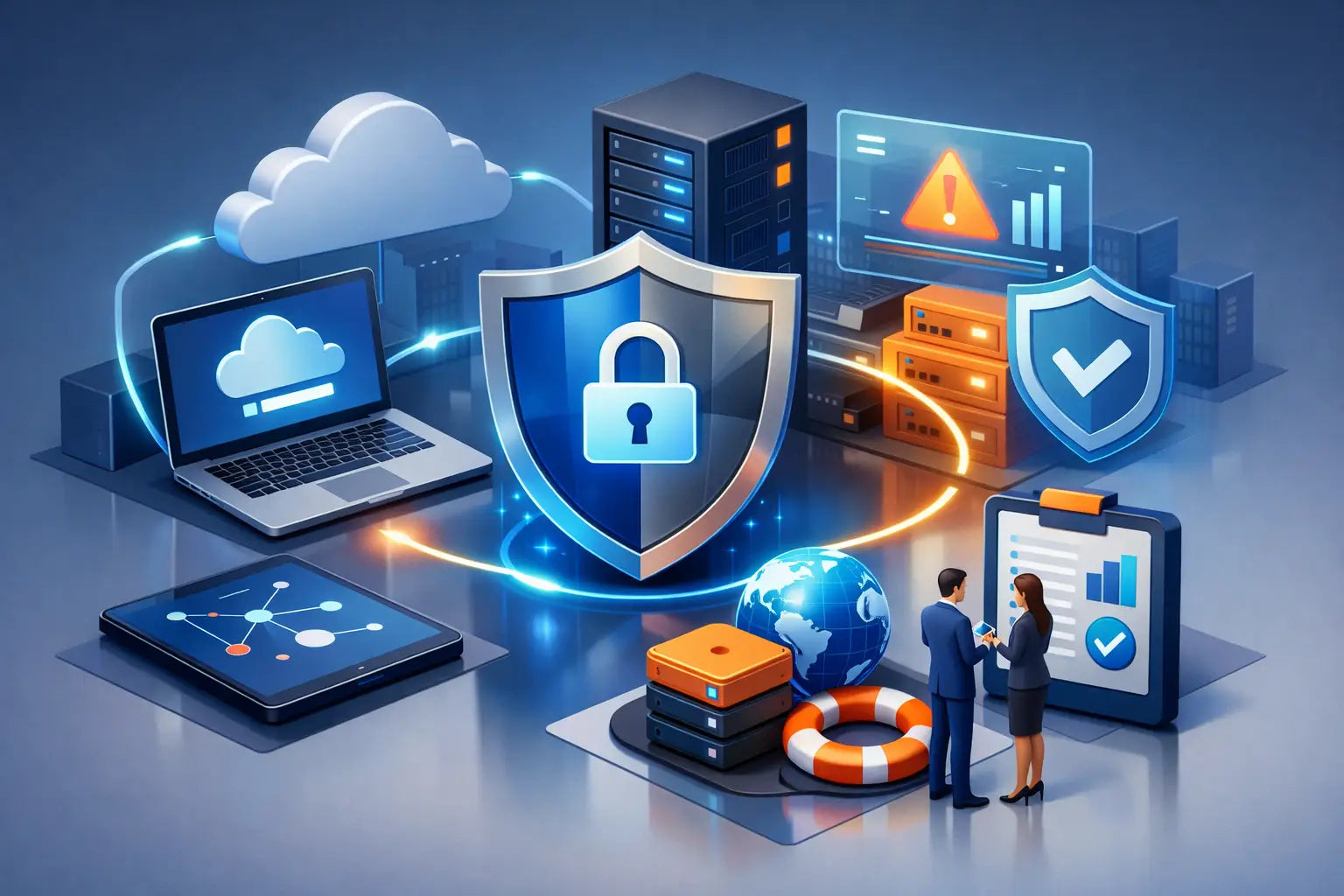
At 9:07 on a Monday, your team cannot access shared files, remote staff are locked out of key systems, and the phones start lighting up with customer queries. That is the moment a business continuity cyber resilience plan stops being a policy document and becomes an operational decision-maker. For Australian businesses facing ransomware, cloud misconfiguration, identity compromise, and supplier risk, the real question is not whether an incident will happen. It is whether the business can keep operating while security teams contain it.
A lot of organisations still treat continuity and cyber security as separate workstreams. One sits with risk or operations, the other with IT or security. That split creates delays, duplication, and expensive blind spots. A workable plan brings them together. It defines how your people, systems, controls, and recovery processes support the business when normal conditions no longer apply.
What a business continuity cyber resilience plan actually needs to do
A business continuity cyber resilience plan should not try to predict every scenario. It should give your organisation a clear operating model for disruption. That means identifying which services must stay available, which systems can fail temporarily, who makes decisions under pressure, and what security controls support safe recovery.
The continuity side is about maintaining acceptable service levels. The cyber resilience side is about anticipating attacks, resisting them where possible, limiting impact when they succeed, and recovering without compounding the damage. Put together, the plan answers three practical questions: what matters most, what can break, and how fast do we need to restore it safely.
That last word matters. Restoring quickly is not enough if you are restoring compromised systems, reintroducing malware, or reconnecting users with stolen credentials. Speed without control is just another failure mode.
Start with business impact, not product selection
Many plans go wrong early because the conversation begins with tools. Firewalls, endpoint agents, backup appliances, MFA, SD-WAN, SIEM, and email filtering all matter, but they only matter in relation to business priorities. If your ordering platform, finance system, warehouse connectivity, or branch access is down, which one causes the most immediate financial or operational harm? Which outage triggers compliance exposure? Which process has a manual workaround, and which one does not?
This is where a proper business impact analysis earns its keep. You are not aiming for academic completeness. You are aiming for a usable hierarchy of services, applications, users, dependencies, and recovery targets. For most SMBs and mid-market organisations, that means mapping a manageable set of critical services first, then drilling into the systems and controls those services rely on.
Some businesses need near-continuous access to cloud applications and secure remote connectivity. Others can tolerate an outage in one area provided finance, customer communications, and identity services stay intact. It depends on how the business earns revenue, serves customers, and meets obligations.
The controls layer that supports continuity
A business continuity cyber resilience plan is only credible if the supporting controls are realistic. In practice, that usually means reducing single points of failure and improving visibility across users, networks, endpoints, and cloud services.
Identity protection is a common weak spot. If privileged accounts are compromised, continuity plans can unravel quickly because attackers gain the same administrative access your recovery team depends on. Multi-factor authentication, role-based access, privileged account controls, and clear break-glass procedures are basic requirements, not optional extras.
Network segmentation also matters more than many businesses expect. If every office, server segment, and critical application sits on a flat network, one compromised device can create a much wider outage. Segmentation gives you options. You can isolate affected zones, preserve essential services, and continue operations in a controlled state while investigation is underway.
Then there is endpoint and server visibility. If you cannot tell which assets are affected, you cannot make sound continuity decisions. Containment becomes guesswork. Recovery sequencing becomes guesswork. So does customer communication.
Unified security architecture helps here because fragmented stacks often slow response. Separate tools with inconsistent policy, limited telemetry sharing, and multiple management points can make a bad day worse. For many organisations, a more integrated approach improves both operational resilience and cost discipline.
Recovery is not just backup and restore
Backups are essential, but they are only one component of resilience. A useful plan defines recovery conditions, validation steps, and decision thresholds. Which systems are restored first? Who signs off that a workload is safe to reconnect? How do you verify data integrity? What happens if your primary identity platform is unavailable?
Offline or immutable backups are valuable for ransomware scenarios, but they do not solve every problem. If recovery takes too long, the business impact may still be unacceptable. If backup credentials are poorly protected, attackers may target the recovery path itself. If your dependencies are undocumented, restored systems may come online without the services they need to function.
This is why recovery testing matters. Not a once-a-year checkbox exercise, but scenario-based testing tied to actual business services. Tabletop exercises are useful for decision-making and communications. Technical failover and restore tests are useful for proving whether the design works under pressure. You need both.
Building the plan around real operating conditions
The strongest plans reflect how the organisation actually works. That sounds obvious, but many are written in language that assumes perfect staffing, complete documentation, and immediate vendor response. Real incidents are messier. Key people are on leave. Contact lists are out of date. A supplier has its own outage. Branch sites lose connectivity. Senior leaders want answers before the facts are complete.
Your plan needs enough structure to guide action without becoming too rigid to use. Clear roles, escalation paths, communication templates, and recovery priorities matter. So does flexibility. If a cyber incident affects only one business unit, your response should be targeted. If it affects identity, core networking, or customer-facing systems, the plan should support enterprise-wide coordination.
For regulated environments, there is another layer. Compliance obligations can influence logging, data retention, incident reporting, third-party access, and recovery controls. A plan that ignores those requirements may restore services yet still leave the organisation exposed.
Where technology decisions shape resilience outcomes
Not every organisation needs the same architecture, but some design choices consistently improve resilience. Consolidating security controls where it makes sense can reduce operational drag. Secure SD-WAN can support branch continuity when connectivity issues arise. Next-generation firewalls with strong policy control and visibility can help contain lateral movement. Endpoint protection and response improves detection and triage. Secure access controls help maintain trusted connectivity for remote users during disruption.
The trade-off is that tools do not fix poor design. Buying more products without a coherent operating model often increases complexity. The better approach is to align security investment with recovery priorities and operational realities. That is where certified guidance has value, particularly for businesses that need enterprise-grade outcomes without building an oversized in-house team.
For organisations standardising on Fortinet, the advantage is often less about any single product and more about coordination across network security, access, segmentation, endpoint visibility, and centralised management. That can make continuity decisions faster and more defensible when incidents unfold.
How to keep the plan current
A business continuity cyber resilience plan degrades quietly. New cloud apps are added. Offices move. Staff change roles. Suppliers change. Acquisitions create exceptions. Before long, the documented plan no longer matches the live environment.
The fix is governance that is practical, not bureaucratic. Review the plan after major infrastructure changes, after security incidents, and after each test cycle. Track recovery assumptions against actual performance. If the business says a service must be restored within four hours but testing shows eight, that gap needs a commercial decision, not wishful thinking.
Ownership is important too. This cannot sit only with IT, and it cannot sit only with risk. Continuity and cyber resilience require shared accountability across technology, operations, leadership, and where relevant, procurement and compliance.
What good looks like for Australian organisations
For Australian businesses, a strong plan is one that matches the scale and complexity of the organisation without overengineering the response. It protects critical services first, supports local compliance expectations, and gives decision-makers clear options when systems are degraded or under attack.
It also recognises budget reality. Not every business can build full redundancy across every platform. That is fine. The goal is not theoretical perfection. The goal is measurable protection, faster containment, and recovery paths that preserve business operations where it counts most.
If your current plan is a static document, or if continuity and cyber still sit in separate lanes, there is work to do. The right business continuity cyber resilience plan gives your organisation a more controlled way to absorb disruption, protect revenue, and recover with confidence. That is not just good security practice. It is a better operating model for any business that cannot afford to stop when the pressure hits.